
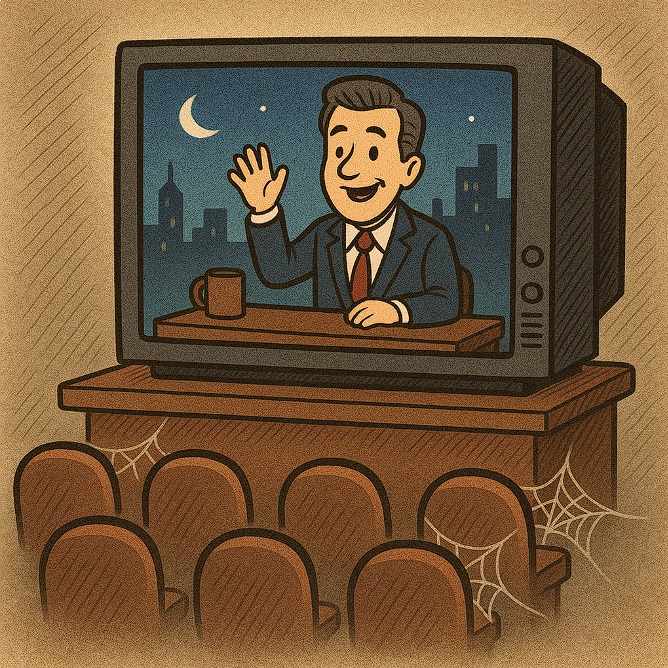
President Donald Trump may have fanned the fire that is burning down Late Night television, but the fire that is burning down Late Night TV started decades ago. Late Night isn’t what it once was. Recent stories about Washington’s political revenge may even give Late Night a temporary viewership boost. But long-term, it is still on a march to the grave. Ratings are down. Way down since the height of viewership back in 1975. And they’re not coming back any time soon.
Mainstream TV is technology as much as it is entertainment. Broadcast TV, the free over-the-air content, took over from radio, which dominated home entertainment in earlier decades. By the 1950s, TV in America meant the Big Three networks… CBS, NBC, and ABC. Talk shows dominated Nighttime TV, and Soap Operas and Game shows dominated Daytime. Sandwiched in between were comedies, made-for-TV movies, detective shows, Westerns, and even the occasional Science Fiction show.
Broadcast TV was… restricted. The FCC had morality-based regulations, advertisers were concerned about consumer backlash, and viewers could form coalitions to boycott shows they found to be inappropriate (such as “All in the Family” and “Three’s Company”). When Cable TV arrived, the FCC did not have jurisdiction over this non-broadcast, private form of entertainment. Cable shows often started with a warning, “may contain adult language, adult situations, and partial nudity”.
In the 1980s, there was an explosion of this “adult” programming, which often won awards. TV programming was now looking more like the movies you would see in a movie theater. Homes went from 3 networks to … many. And Broadcast TV looked a lot less interesting. But before viewers could catch their breath, videotapes (and DVDs) appeared. Blockbuster outlets were in every city in America. Home consumers could watch every movie ever made. And porn. A LOT of porn.
In the early 2000s, cable cutters just went online for almost anything. Napster and then YouTube have both mainstream and very, very niche content—often for free. Streaming services, like Netflix, are today’s top dogs, with just about every content creator and studio opening up their vaults to the world (Paramount, Disney, CBS, Hulu, Apple TV, etc.). For a small monthly fee. Networks must provide their content for free, hobbling revenue streams for broadcast shows.
Daytime broadcast shows, especially Soaps and Game shows, are going through their own decline. Daytime programming was once aimed at stay-at-home moms. Most women now go to college and get jobs, devastating the viewership.
However, the concept that was created by soap operas… serialized story arcs with multiple sub-plots… lives on. Most Netflix shows follow this pattern. “Game of Thrones” may be the best example of this style. However, “back in the day,” there is NO WAY that the FCC would allow GOT to get on the air. Yet, if the FCC were not so puritanical, neither Cable nor Streaming would ever have been created. And, the new technology of streaming, plus elements from old soaps, gave us the Juggernaut of GOT. Entertainment continues to evolve. Just not on Network TV.
And consider 1970s game shows, like “The Dating Game”. While it is long gone, the general idea lives on. Could “The Bachelor” exist without the Dating Game? Probably not. And once the last rose on the Bachelor has long since withered, it will probably return with a new name and an updated format (maybe as augmented reality?), but it will return. Are you listening, Late-Night? The audience changes. The technology changes. And Late Night programming MUST change to survive.
When Johnny Carson hosted The Tonight Show, Late Night was in its golden age. Carson’s show wasn’t just another talk show—it was the talk show. Future stars like David Letterman, Jay Leno, and Joan Rivers first cut their teeth as Carson’s guest hosts. While Late Night programming only covered an hour or so, Carson’s reach went far beyond his own time slot.
NBC executives recognized the power Carson had over his audience and worked to capitalize on it. After Carson signed off, plenty of viewers were still wide awake and looking for something to do. So, in 1973, when other stations signed off for the night, the first truly successful Later Night show was just warming up… “Tomorrow with Tom Snyder”. NBC’s gamble worked out, and a new type of programming was born.
But there’s more! The Tomorrow Show gained its audience by merely being after Carson. But the next morning, your dial was still set to NBC. NBC’s “Today” show dominated the morning ratings for decades. NBC (and other networks) assumed that the “dial Lock” from The Tonight Show lasted until the following day. If true, that made the Late Night slot the most powerful of all, dominating a third of all weekday programming hours.
Carson is long gone. Since then, ratings have been in decline for decades. Has the audience changed? Yes, it has. But more than the viewers have changed. In the early days of Carson, there were three national networks with a broadcast day that ended at Midnight or earlier. Now the day is 24 x 7, with an infinite number of cable and internet “channels” competing for viewer attention. And, of course, there are new forms of entertainment. Console games, video chatting, online gambling, social media influencers, YouTube videos… and more. It’s very, very hard for Late Night programming to attract and hold onto users.
Where does this leave the big three Late Night talk shows? Pretty much in the dumpster. Late Night has virtually collapsed over the last few years. The best-performing Late Night show is “The Late Show with Stephen Colbert”. Ten years ago, they had 4 million nightly viewers; now they have just 2.4 million viewers. That means they are down 50% in ten years, and down as much as 90% since Carson. Jimmy Kimmel and Jimmy Fallon are in even worse shape, with just 1.8 million and 1.2 million viewers.
Can these three Late Night shows survive? Probably not. The main reason they are still on the air is that everything else the networks have tried in late or later night programming has been even more unpopular…. late night news, comedies, and other traditional entertainment. They all failed. I suspect that all three networks know that they have to do something, but none of them wants to give up a time slot to the competition.
Well, there are always infomercials!
What do you think? Do you watch Late Night shows? If not, if you were in charge, what would you want to see in this time slot? Or, would you spend your Late Night hours doing something other than watching Network TV? Tell us what you think!
 Niccolls AND Dimes