
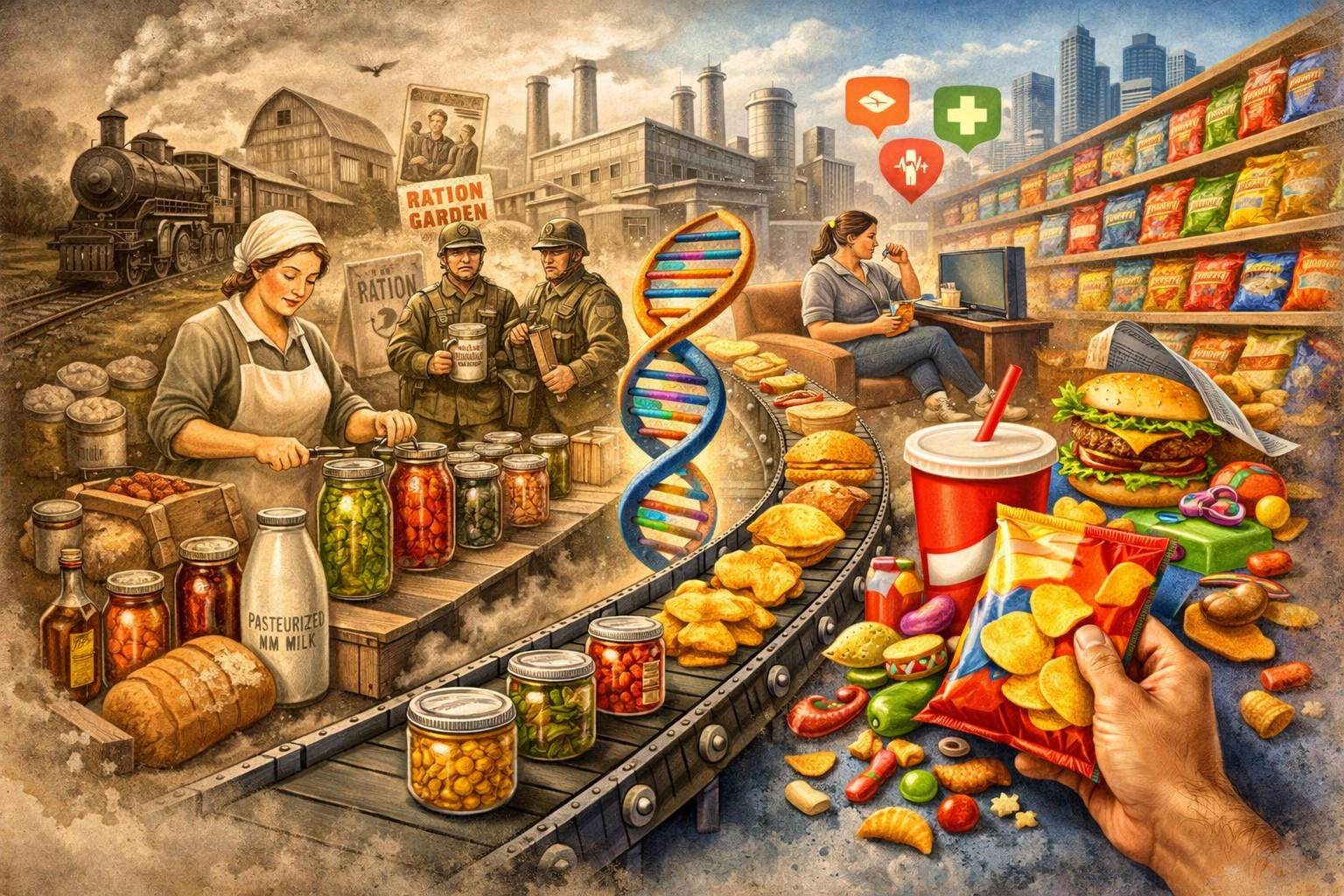
Seated safely in the 21st century, it’s easy to walk through an American grocery store and feel a quiet alarm. Ingredient lists can read like lab inventories. Tongue-twister additives that make food last for months. Calories are cheap and everywhere. And with a little more chemistry, our food can be so engineered for pleasure it feels almost… irresistable.
Here’s the twist: most of what now worries us was once celebrated as progress. It made food safer, cheaper, and more reliable. America’s food system became the envy of the world, a genuine triumph. How did yesterday’s miracle become today’s health crisis?
The world before abundance
Around 1900, food was local, seasonal, and fragile, and it could be dangerous in ways we’ve mostly forgotten. Consider milk. Before widespread pasteurization and modern sanitation, milk could carry disease. In a single year in New York City, 8,000 infants died from impure milk.
But regular epidemics of food borne disease was normal in an era before strong federal oversight. Outbreaks of contamination and spoilage were common. Even deep into the 20th century, the U.S. saw hundreds of cases each year of trichinosis, a parasite linked to pork and wild game that can cause severe illness and, sometimes, death.
Scarcity isn’t just about calories. Nutrients are just as importnat. Before WWII, most people didn’t understand vitamins and micronutrients. Inland America had limited access to seafood, which meant limited iodine. Without iodine, thyroids swell and malfunction. The Midwest earned the grim nickname “the goiter belt,” where swollen necks were common and the consequences were serious, including hormonal and heart problems.
Meanwhile, everyday staples spoiled quickly. Bread went stale or moldy in days. Working families couldn’t afford to toss food. So when products arrived that were a little less “fresh” but far more durable, people bought them with relief, not suspicion.
The great safety revolution
Then came the breakthroughs that changed human life.
Pasteurization spread and infant deaths plunged. Canning brought vegetables through winter. Refrigeration moved from luxury to normal. Preservatives slowed spoilage and reduced waste, helping feed growing cities.
These weren’t cynical tricks. They were victories over an older world that killed people with germs and hunger. Newspapers praised “modern foods.” Governments encouraged innovation. Families trusted the new system because it delivered something priceless: reliability.
Kraft, one of the largest global food companies, began as a humble cheese distributor. But one day Kraft created “Processed Cheese”, a product that lasted far longer than natural cheese. The secret ingreedient? Salt… and a lot of it.Over time, Kraft developed emulsifiers, preservatives, thickeners, and flavor enhancers, resulting in Cheeze Whiz… a product that is barely recognizable as cheese.
At the time, a clean, scientifically managed food factory sounded far better than something that came form the dirt and sold without temperature control. The new food system didn’t just feel convenient. It felt safer. And for a long time, it truly was.
The industrial promise
After World War II, efficiency became a national religion. The war proved what logistics could do. If industry could supply armies, it could supply a country. Food science exploded as additives helped prevent separation, stabilize emulsions, protect texture, restore color lost in processing, and boost flavor, Magazines celebrated “modern kitchens.” Pantries filled with packaged goods that promised convenience, consistency, and freedom from daily cooking.
Food factories had the same goal as the American family… affordable, consistent food, that stayed fresh forever. Food conglomerates focused on making this highly processed food scalable enough to feed a growing population without famine. And it worked. By the standards that mattered then, the American system was a masterpiece.
The quiet shift
The problem isn’t that we built those tools. It’s that we never stopped building them. Once America had food security, why continue to tinker witht he very definition of food? Refrigeration was everywhere, did we really need “nearly pototo chips” in a tube? Foodborne infectious disease declined. What were all of those difficult to pronounce ingredients going to do for us? Global trade made fresh food available year-round. In developed nations, famine became rare. The emergency, in many ways, had passed.
But the machinery kept running, still optimizing for shelf life, cost, and uniformity, even when the biggest threat was no longer spoilage. And once the system mastered “safe and cheap,” it moved to “profitable and irresistible.”
Additives designed to protect food were increasingly used to perfect mouthfeel. Sugar, salt, and fat were tuned for craveability. Texture engineering replaced cooking. Flavor amplification replaced ingredients. Color correction replaced freshness. Packaging got smarter and more complex, extending life even longer. Hyper-safe, irrisistable kiddie food didn’t need the rainbow of colors in Fruit Loops, but their kid magnet colors just might sell a few more boxes of cereal.
This didn’t happen overnight. No villain kicked down the door. No secret committee plotted humanity’s downfall. Each step had a reasonable argument: lower cost meant wider access, longer shelf life meant less waste, better taste meant happier customers.Great, we had an inexhaustable supply of cheap and irresistable food. But… did evolution prepare us for this food Bonanza?
From solution to side effect
Humans didn’t evolve for an abundance of ultra-processed food. Our appetite and satiety systems were built for scarcity, variety, and effort, not for soft, fast calories engineered to slide down without ever triggering “I’m full!” When food becomes cheaper, sweeter, and easier to consume, abundance turns into overload. We don’t just eat more. We eat differently, and our biology struggles to keep up.
The 20th century’s achievements deserve recognition. They reduced starvation, stabilized supplies, and helped push back diseases that once haunted every family. But success in one century doesn’t guarantee safety in the next. Engineered food saved us from hunger in the 20th Century. Now we need something to save us from engineered food.
For most of human history, hunger shaped our lives. Our old idea of paradise was a table that never ran empty, piled with sweets and rich foods. Now we’ve built something close to that dream, and it turns out the dream has teeth. Are we living in the best or the worst of times? In 1900 the average American lived to an average of just under 50 years old. Today, we live to be just under 80 years old. America has the world’s highest levels of obesity, diabetes, and heart failures. But in 1900 over 250,000 American’s died directly from diseases of malnutrition, and may more from indirect nutritional issues.
What do you think?
 Niccolls AND Dimes