
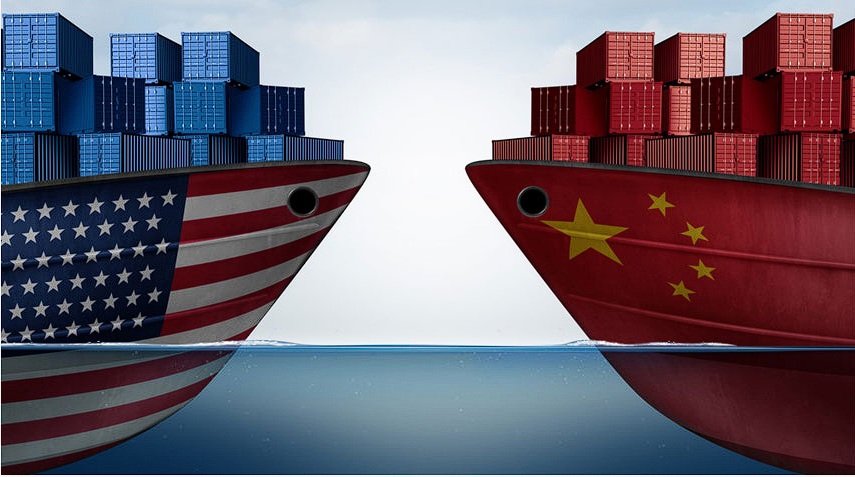
A federal department to collect taxes and payments from other nations, non-U.S. entities, and external sources could work! It might even be a pretty good idea… IF Trump is willing to go all the way. Trump seems to be primarily thinking of the “Department of External Revenue” to collect tariffs. That’s a step in the right direction. Trump’s admitting that it will take a new department to manage all of his new tariffs. But tariffs are only a part of what needs to be done.
TARIFFS: Tariff targets keep changing. The 2025 Trump Tariff Target seems to fall around 60% for China. And around 20% to 25% for the rest of the world. That means a tariff of $350 billion for China. And another $550 billion for the rest of the world. That’s a decent start, but it does miss quite a lot. For example, many Chinese factories are not in China.
As early as 2000 China saw the writing on the wall. As more work moved to China, factory owners in Europe and America cried foul! The US and Europe started to tariff China decades ago. China’s cost of labor has been rising for over 20 years. As a result, they followed the same tactic as their American and European customers. China moved to factories in Vietnam, Cambodia, and other East Asia locations. These factories may reside outside of China, but the money, the management, and the control stayed Chinese. Some of these “offshore” factories sent goods directly to America, some made parts that were used in China, and some… did something else.
In the messy and very complex world of experts, what is the right tariff for “partially” Chinese products? Should it be the higher Chinese tariff rate, or the lower rate that the “rest of the world” is charged. As you can see, tariffs can be complicated. And over the next 4 years, we can be certain that the rates will change. Remember, there are already thousands of tariffs on the books. Some products are protected by powerful lobbyists… like American Beef. Some products not only have tariffs, they also have quotas (limits on total imports).
How we classify quotas is no small matter. If more offshore factories are considered Chinese, it could add hundreds of billions of dollars to tariffs. We should remember that China is building factories and investing around the world, not just in East Asia. Back in 2013, China introduced the Belt and Road initiative…. China’s “New Silk Road”. A massive global collection of roads, ports, and factories designed to place China at the center of worldwide trade. 145 nations have signed agreements for China’s Belt and Road initiative. If the goal of the Trump Tariff is to contain China, how do we classify Belt and Road-owned products?
We should also remember, that we’ve been down this road before. In the 1980s we thought that Japan would take over the world’s economy. So, we enacted extensive tariffs and quotas to slow down Japanese imports. Japanese cars were considered better built and less expensive than U.S.-made vehicles, so big US automakers demanded action from Washington. The result? Japanese manufacturers moved to the US. Is that a path for China? It might make sense from an employment point of view but from a national security point of view? If TikTok threatens national security, factories owned by the Chinese Communist Party will (and should) never be accepted.
INTELLECTUAL PROPERTY: Trump tasked Elon Musk with closing a $2 trillion federal budget gap. If the Department of External Revenue collected unpaid Intellectual Property (IP) license fees, we could significantly shrink that gap. China systematically violates copyright laws and then protects Chinese violators. China steals more IP from the US (and Europe) than anyone or anything in history. There is ample evidence that the Chinese government directly supports and encourages this theft. It’s everything from knockoff handbags to classified military equipment. China has even stolen from its “ally”, Russia. China’s most advanced jet fighter, the Chengdu J-20, is universally recognized as an unlicensed ripoff of the Russian MiG-1.44. Even Putin thinks China’s business practices are unethical.
As with all complicated issues, estimates will vary. The cost of Chinese IP theft probably falls between $225 billion and $600 billion, annually. Preventing future IP theft is a very significant issue. Fully collecting IP license fees would help level the global playing field, reducing the Chinese cost advantage.
OFFSHORE BANKING: Corporations (US & Foreign) use tax loopholes and criminal schemes to hide money in offshore banks. Why? To avoid paying taxes. It is estimated that $4 trillion has been moved beyond the reach of the Internal Revenue Service. But are these funds beyond the reach of the External Revenue Service? Maybe not… IF these accounts fall under the mandate of the External Revenue Service. If properly taxed, these accounts could add as much as $600 billion to federal revenues.
What do you think? Should “balancing the books” with China and other nations involve more than just tariffs? Should we pursue offshore banking and IP theft… and maybe even more ways to reclaim money that the US is due? Tell us your opinions and ideas.
 Niccolls AND Dimes