The New iPhone 9 Is Made In America!


apple-tim-cook

(Previously published in AndMagazine 12/17 2016)

Every time a new iPhone comes out, tech and style feeds explode with stories about new first opinions and new tech features.  Well, I don’t want to comment on the features of the iPhone 8, but one of the most interesting features of the iPhone 9 will be where it’s manufactured. Outsourcing is a hot issue for the Trump Presidency, and products like the Phone that are manufactured offshore will be targeted by trump for penalties. How will this affect your next phone? Let’s take a look!

Of the top 10 smartphone manufacturers, only Apple is still US based. The rest are all from brands that are headquartered in Asia. All of the top phones cost about the same, around $700 for an unlocked phone without a contract. The Trump plan (so far) is to tax American products that are built, or assembled, or worked on offshore. Trump believes that a 35% tax on these products will make phone manufacturers build these products once again in America.

Today, the iPhone is primarily assembled in China, for around $4 to $6 per hour. If an American factory built iPhones, it would cost just under $35 per hour (not including the cost of a new factory) to assemble electronics. It takes 23 hours to build an iPhone, which means that the cost of an American built iPhone would be about $1,400. Of course, almost all of the parts in that phone were manufactured offshore. Building dozens of new factories and paying US wages would raise the cost of the phone to $2,000 to $3,000.

You may love your iPhone, and you may love American built products, but will you ever love an iPhone that costs $3,000? Of course, there are other options. It takes 23 hours to assemble an iPhone because the factories in China that do the work, are not very automated. If the work is moved onshore to an advanced, state of the art factory in the US, and the work was automated down to just 2-3 hours, the price of the phone would be virtually unchanged. However, there would be very, very few jobs.


Alternatively, Apple could pay Trump’s “outsourcing tax” of 35%. That raises the cost of an iPhone to $925. That’s still a big price increase, but since the iPhone is the only American phone what choice will consumers have? Oh, right. Consumers have a lot of choices. Like Samsung, or LG or any of the other foreign brand phones. Taxing the iPhone would only eliminate the US as a major player in mobile phones.

It doesn’t really make a lot of sense to penalize the last standing US manufacturer of mobile phones. The problem is that there are a lot of products that America no longer produces or that we only have one or two manufacturers left. After all, Trump said that he chose to manufacture his line of men’s clothing offshore because there weren’t any manufacturers left in America. He’s right, there are a few men’s clothing makers left in America, but the vast majority has been offshore since the 1980’s. Maybe Trump outsourcing plan should only focus on a few select industries?

We definitely want to keep high-tech industries in the US, so what other options do we have? Well, we could have an across the board tax on all mobile phones. Yeah, that would work! Every phone would cost a few hundred dollars more, and it just might trigger a trade war with China and the rest of the world, but it might return a few jobs to the US. Of course, if we went further and taxed all imports, we would definitely have a trade war. We would also increase the cost of more than half of the things that American families buy.

Years ago, Walmart was the cutting edge of outsourcing. They replaced American products with much less expensive products manufactured in China and other offshore locations. Slowly,  Walmart grew and replaced many competitors across the US because of their lower prices. Jobs were lost, but consumers greatly benefited. A study from 2010 showed that the average American family saved $2,500 to $3,000 every year just from their savings from shopping at Walmart. If you took all outsourcing into account, American families gained $5,000, $10,000, or more in purchasing power. When outsourcing ends, what happens to that purchasing power?

The problem is that we both consumers and workers. Cheap offshore products don’t create a lot of good jobs.  But middle-class America could also use a raise, and the loss of inexpensive but good products hurts too. The President and Washington may play a big part in writing national policy, but it is the average American that ultimately chooses which products are bought and which are ignored. Give it some thought America, one way or another Apple is going to build an iPhone 9. You get to choose where it will be built!


Posted in Decision Making, Employment, Robots | Tagged , , , , | Leave a comment

Castro Is Dead! So… Who Owns Cuba?


Press conference, Havana

(Previously published in AndMagazine 12/12/2016)

Fidel Castro is dead, and his brother Raul (current leader of Cuba) at a mere 85 years old, must be thinking about his succession plan. For nearly 65 years, Cuba has been quietly sitting just 90 miles off the shores of Florida, enjoying the dubious benefits of Communism. During almost all of this time, Cuba has been under embargo, cut off from trading with most of the world. Now, is the embargo over? Can America really have a normal relationship with Cuba?

Before we answer that question, let’s go back to the beginning of the silent war between the US and Cuba. Why did America create the embargo? In the 1950’s. Cuba had a dictator, President Batista. America agreed that he had to go, and out of the many revolutionaries who wanted to forcefully overthrow Batista, we backed a young and charismatic lawyer by the name of Fidel Castro, and his sidekick Che Guevara. The revolution came, Fidel won, but then something unexpected happened.

The 1950’s and 1960’s was a time of revolution in South America, and the US backed a lot of revolutionaries. Usually, after the revolution, banks reopened, new casinos went up, and the revolutionary (hopefully) became a less bloody dictator than their predecessor. Castro, however, was serious about his promise to divide farmland among the farmers, nationalize banks and corporations, and create a socialist government. 20 years earlier a young and idealistic Batista joined a revolution that made him the President of Cuba, but the temptations of the job quickly turned him into a corrupt dictator. Fidel was determined to be different.

Whether Castro’s government was good or bad, or whether Fidel was a worse dictator than Batista really doesn’t matter anymore. What does matter is that Fidel took a lot of private property and put it into public hands, which triggered the economic embargo in 1958 (expanded in 1962). For half a century, Cuba would be frozen in time, eternally stuck in the economy and politics of 1962.

“Expropriating” private property started the embargo, but the missiles wrote that policy in stone. In 1961 America tried, and failed, to undo Castro’s revolution with our own revolutionaries at the “The Bay of Pigs”. The White House unsuccessfully denied that the counter-revolutionaries were recruited, trained, armed and funded by America. Then, America found signs of Nuclear weapons arriving in Cuba. Foreign nuclear weapons just 90 miles from US territory was completely unacceptable to America. President John Kennedy told the world that it was an unjustified act of war that would trigger a nuclear war. The missiles must go!

And go they did. After very tense negotiations between the US and Russia, it was publically agreed that Russia would remove the missiles and America would give up any invasion plans for Cuba. Privately, America removed its own nuclear weapons that were secretly placed in Italy and Turkey and targeted at the Soviets. President Kennedy was unaware of these missiles, which were probably the real reason for missiles in Cuba. Throughout the crisis, only the US and the Soviets were engaged in negotiations, Cuba was not invited. The Missiles were made in the Soviets Union; Cuba had (and has) no capability to build missiles  or nuclear weapons. The agreement to remove the missiles ignored Cuba.

Yet, the embargo against Cuba lasts to this day. On the other hand, the Soviet union, the most powerful communist nation on earth, closed down in 1992. All but 5 (including Cuba) of the 50 communist nations of the 20th century converted to Democracy, leaving just China as the sole significant communist nation. Naturally, as the most populous nation, with the largest army, nuclear weapons, and a huge manufacturing base, this communist nation is… America’s biggest trade partner.  Yet the embargo still stands for Cuba.

Communism is gone, the Soviets are gone, we’re in a new century, Cuba has not been a threat in half a century and… Fidel Castro is dead. In Miami’s Little Havana neighborhood, ex-Cubans are dancing in the streets. Raul, Fidel’s slightly younger brother, took over the leadership of Cuba in 2011. While he looks a bit more energetic than Fidel did, he doesn’t look that good. Retirement or death is in Rahul’s near future. Then what happens?

Cubans who left Cuba and settled in Florida and surrounding areas are a strong voting bloc, with an almost religious belief that once Fidel died, they would be “compensated” for their losses and suffering. For some, this might just mean being reunited with their families. But many who left or “escaped” Cuba in the early 1960’s were wealthy landowners. They created the political culture of Cuban-Americans, and they want their property back. Later Cuban arrivals were poor and willing to risk death on the open sea for economic opportunity. Not all Cubans have land issues, but landowners shaped Cuban politics in America.

Realistically, ex-Cubans can never be made “whole” again. Families that once owned a sugar refinery would only find a closed factory, crumbling concrete, and rusted metal. If they are lucky! More likely they will find that the factory was dismantled and replaced by someone’s home.

Big land owners? In the 1950’s sugar dominated Cubas’s agriculture, just as cotton did in pre-Civil War America. Cuba was a land of sugar plantations, with very wealthy landowners and many poor farm workers. Plantations broke up a long time ago. The old life of Cuba, as viewed by American tourists, looked like an earlier version of Las Vegas. Away from the City, it looked more like, “Gone With The Wind”. Both images are true, and both have been gone for a very long time.

What can Cuban-Americans expect? Lawyers! Cuba will soon be crowded with high-powered international lawyers looking to compensate their clients for what they lost. Not much land can be transferred because the land now has other owners and other occupants. A little bit of that property might go back to old owners, but not much. The property that Castro took over has been estimated at around $50 billion. If the economy of Cuba recovers, it would be worth even more.

A distant and impotent enemy can be a good thing. Enemies bring together factions. But when the enemy dies, disagreements surface. Can Cuban-Americans be a coherent political force without the dream of a free Cuba? Not all Cubans will benefit equally in coming days. Will this tear apart the unity of Cuban communities? Fidel Castro is dead and Rahul Castro is working with America to undo the old embargo. A free Cuba is almost here. The worn streets and poor people of Cuba tell us the cost of the Cuban embargo. How we’re all going to learn the cost of lifting the embargo.  Only time will tell which is higher.


Posted in Decision Making, Unique Ideas | Tagged , , , | Leave a comment

Can Trump Bring Jobs Back To America?


trump-outsource

(Previously Published in AndMagazine, 11/21/2016)

During an election, politicians make promises. But after the election, we find out what truly matters. Their track record gives us clues, but, as pundits have pointed out, President-Elect Trump lacks a track record. He’s never been elected or worked in government. But he was a very public businessman for decades. He even wrote a book. (Well, 20, but “wrote” may be an exaggeration.)

Trump’s promised to bring jobs back to America. We already know that he is offering business incentives to create jobs and guidelines to reign in outsourcing. But how exactly will this work? Let’s break down the issues…  

Where are we today: Millennials are leaving college with graduate degrees, but working in Starbucks. Coal miners want America to reopen mines in this economically devastated region. But American’s don’t want to burn coal. Besides, in areas like Kentucky, coal is just the crisis that followed the collapse of the Tobacco industry, years earlier. Manufacturing has shrunk to just 8% of the economy, as work moved to offshore factories offering cheap labor.   

The problem that Trump will face is that today’s employment problem was yesterday’s employment solution. Tobacco farms and Coal mines have closed because both industries produced damaging, dangerous products. Tobacco use is way down, and so too is lung cancer. Fewer coal mines mean fewer coal mine collapses and deal coal miners. But that doesn’t compare to the deaths from “black lung disease” in coal workers, and other ailments from the pollution caused by coal use. Most people complain when someone smokes next to them. Imagine having a coal powered electric plant opening down the block from your home.

Problem or solution: Outsourcing cost American jobs, but it also lowered the cost of… everything. Walmart once led the charge for offshoring, reducing costs by introducing America to products that were made in China and elsewhere. Back in 2010, an analysis of Walmart concluded that all of these outsourced products saved the average American family $2,500 to $3,000 every year. In the poorest areas in America, Walmart has replaced the hardware store, department store and local grocer. “Un-outsourcing” Walmart be hurt all consumers but will be devastating to small towns in poor states, where Walmart has the highest sales.

By the 1980’s America had moved from a nation of factories to a nation of service providers. The service industry has both low paying (fast food, taxi drivers, hotel clerks) and well-paying jobs (financial analysts, lawyers, doctors, accountants). Graduating students want the high paying jobs. Or should I say need, if they ever want to pay off their student loans? Yet, these graduates are also consumers, who want more efficient, more digital services. Look at the apps on your phone. You can scan checks, pay for purchases, book vacations, etc. These functions were once jobs. As apps become more powerful and more connected, more jobs disappear. Automation and Artificial Intelligence have replaced more jobs than outsourcing.

The dealmaker: How will “Art of the Deal” Trump fix the problem? Apparently, the President-Elect is… making deals. Before the Election, Ford Motor Company announced the move of some manufacturing from Kentucky to Mexico. After Trump spoke with the Chairman of Ford, the work will remain in Kentucky. It’s hard to say how many jobs this saves or if it is only a temporary fix, but it creates credibility for Trump, which will fuel more dealmaking.

Apple Inc., for example, has been making noises about being open to moving iPhone manufacturing to the USA. Does Trump have an app for “opportunity knocking”? Apple could start reshoring (moving work back onshore) the iPhone tomorrow if they want to. But there will be a cost. Literally.

The onshore difference: Foxconn assembles iPhones in China, and pays workers $4 per hour. If we add benefits and other costs, it could be $6 per hour. A comparable US worker is paid $26.50 per hour, $34.45 with benefits. An iPhone costs $700 and takes 23 hours to assemble. Assembly in the US raises costs by $650, making it a total of $1,350 (not including the cost of building a new factory). Of course, every part in that phone is manufactured offshore. Reshoring that would cost hundreds or thousands of dollars more. 

The onshore price won’t sell any iPhones. You could build a factory in Georgia where the minimum wage is $7.25 an hour, but not many workers will be interested. Higher costs could be offset if the onshore factory was highly automated, reducing assembly time to less than 4 hours. But if you build factories with that much automation, you move work back to the US, but you don’t create a lot of new jobs.

Adidas recently followed this model. For decades, running shoes were made almost entirely offshore. But Adidas built a factory in Germany in 2015, and is building a second factory is Georgia for 2017. Reebok and Nike are discussing factories of their own. Placing factories near major consumer markets will slash transportation costs. However, to make the factory financially viable, most of the jobs are performed by robots. Worked moved, without moving jobs.

Power tweeting: Trump has been America’s most social-media enabled candidate… EVER. Even if he scales way back on Twitter, he will still be the “social media” President. As head of Trump inc., Trump relied on the power of the executive to mandate a lot of changes. As the President, he will do the same, but Congress tends to react negatively when executive powers are used too often, and the power of Congress are bypassed.

Successfully combining executive power with social media would give Trump an enormous advantage. Instead of speaking to citizens in just one or two State of the Union speeches, Trump would have immediate communication. For example, citizens can tell him if outsourcing firms brought offshore workers to the US to replace onshore workers. It’s legal to do this IF there was a search for local workers, IF the worker was paid at local rates, and IF that worker has an H-1B visa. Trump can issue executive orders to limit the number of new and renewed H-1B visas (currently over 300,000). Trump can use Twitter and other tools to prep businesses about upcoming changes and ask citizens to report violations. Likewise, when money is allocated for fixing roads and bridges, social media can gather citizen opinions about government priorities, and see how they align with citizen priorities.    

New legislation: Any lasting changes will require new laws and regulations, but that’s probably not going to be one of Trump’s strengths.  Long detailed arguments over points that everyone’s been chewing on for decades? No, not Trump’s specialty. This is where we’re going to see Trump throw out a few key points and wait for something to show up for him to sign into law.

What’s the score: Trump has some easy wins early on that can show his commitment to returning jobs to America. However, as time goes on Trump will have more issues and the occasional global crises to manage. Employment issues are just going to get more difficult. Self-driving taxis and trucks will eliminate driving jobs, and fast food and cashier jobs will be taken over by technology. On the high end, professional jobs will at first be supported by Artificial Intelligence, and later replaced. Will Trump be able to remain focused for four years? Only time will tell!

Posted in Employment, Uncategorized | Tagged , , , | Leave a comment

Hail to the Chief’s… Daughter? Ivanka Trump and the White House


ivanka-trump

(Previously Published in AndMagazine, December 7th, 2016)

Ever since Ronald Reagan’s Presidency, the First Lady has done a lot more than bake cookies and gives tours of the White House. At the start of every Presidency, there is speculation about how involved the next First Lady would be in official White House matters. If Hillary Clinton had won the election, we would be all be guessing about the duties of the President’s Husband (the First Gentleman?). But Trump did win, and now it is time to consider the role that will be played by what could be the most powerful woman in America… the First Daughter, Ivanka Trump!

While Nancy Reagan was in many ways projected the image of a traditional housewife, she was also the gatekeeper to the President. Because Reagan was partially deaf in one ear but didn’t make this public until many years later, he sometimes appeared to not be paying attention or not engaged. Nancy often accompanied Reagan to “interpret” what was being said around the President. Over time she naturally became the guardian of the President, the gatekeeper to the power of the White House.

Nancy Reagan also played a significant role in policies for the growing drug epidemic of the 1980’s. When George Bush senior took over residency in the White House, some expected Barbara Bush to look for some issue to pursue, but she believed that the role of the President’s wife was to be… the president’s wife. But when the Clinton’s took power in Washington, Hillary showed that she could handle power roles as the First Lady, and later as Senator from New York and Secretary of State.  

Now, as President Trump is packing his bags for a four year trip to Washington, speculations has begun about our government’s next Power Couple. Yet, few see Melania as a woman with strong political beliefs. During her time as Trump’s wife, she has had little exposure in the press. While Melania speaks five languages, there is not a lot that is known about her ambitions and beliefs. We all know that she used to be a model, that she is Trump’s wife, and she is the mother of Barron (Donald Trump’s son).    

Alternatively, we know a lot about Ivanka. She is clearly the most trusted (and loved?) of his adult children. She was the most seen advisor, who gave the most introductions as her father led rally after rally during the election. Ivanka is the second oldest, but best known of Trump’s children, although Barron (the youngest) may give her some competition once Trump is President. The press clearly sees Ivanka as the most successful, and most articulate of the Trump children.   

As Trump gets closer to the day when he must separate his business interests from the work of the Presidency, what role will Ivanka fill? In earlier discussions Trump has hinted that Ivanka will run his business, she has sat beside her father in meetings and calls with the President of Turkey, the Prime Minister of Japan and the President of Argentina. Undoubtedly, more world leaders will follow!

The latest tidbit is that Al Gore was looking for an opportunity to speak with Ivanka about global warming. When Gore arrived at Trump Towers he was surprised to see Ivanka with her father. In Washington, as Gore was the outsider, with the losing party, wanting to speak on an issue that Trump publicly dismissed as a hoax. Normally, Gore wouldn’t get an opportunity to gain credibility by speaking with the President. Is trump more flexible or is Ivanka more influential?

Ivanka has signaled that she is very interested in the environment and wants to make it her issue. However, for the environmentalists who are hoping that this means Ivanka will save the environment. Well.. That may be a bridge too far. Being interested and agreeing with environmentalists are two different things. If this is where Ivanka will make her stand, the process of learning about the environment may shift her opinions, and in turn, slowly move her father’s opinions. She could just as easily turn out to be a brilliant spokesperson for consuming nature at a faster pace to build a prosperous nation. Too, too early to tell!

The record-breaking part of Ivanka story is that she may be the first, First Daughter to overshadow the First Lady. This has taken a remarkable series of “accidents”. If Trump wasn’t 70, he wouldn’t have children that are old enough to be considered for senior roles. If Donald’s wife, Melania, had stronger political ambitions, there would not be as prominent a vacancy for Ivanka to fill.  Add to that Ivanka “costarring” role with her father on reality TV, her performing substantive roles in Donald’s Trump’s empire, and her prominent position in the election. Ivanka is known to as many of the rich and powerful as her Dad, and he experience in managing the Trump Tower deal in Turkey (a role she played long before her father ran for President), clearly demonstrates that he has credible executive experience.

None of us know, including Ivanka, what her role will be, but it seems to be naturally shaping up that she  will have some role, either in the government or as an unofficial “spokesperson” for a serious issue like the environment, just as Lady Diana championed animal rights and the outlawing of anti-personnel mines. Will the First, First Daughter be an effective leader and role model for women around the world? Maybe she should ask for tips from her BFF Chelsea Clinton!

Posted in Best Practices, Decision Making, Unique Ideas | Leave a comment

What will be the most important drivers of change in the global sourcing arena over the next decade, and why?


future

(Previously published in Outsourcing Magazine, on August 16, 2016)

For the last few decades outsourcing has been on a journey… literally! Outsourcing once meant having another company do your work, perhaps on your property. Later, outsourcing meant moving work to the suburbs. When work went digital, it moved to another town, in another state and soon to another country. China and India once looked like the ends of the Earth, but we kept moving… to Bangladesh, Vietnam and beyond. Where will outsourcing go when we have truly reached the ends of the Earth?

20 years ago I managed a New York investment bank’s support services. We needed to add staff, but our headquarters was full. We had space a few blocks away, but breaking up the staff created major inefficiencies, because workers were trained to work side-by-side, in one big room. When we learned to work “remotely”, efficiency improved everywhere, including our headquarters. If moving blocks away worked, nothing was stopping us from moving work halfway around the world!

In a few months, we had a successful pilot program in India. In a couple of years, every Fortune 500 company had pilots in India or China. The “ends of the Earth” were getting crowded, and it was obvious that costs would soon rise. Purchasing departments were also evolving, becoming procurement departments, and demanding ongoing year-over-year cost reductions.

An experienced outsourcer knows that lower-cost wages offshore initially deliver big financial benefits, but in a few years those benefits are lost to inflation when the program does not incorporate continuous improvement. Offshore locations often have twice the rate of inflation of onshore programs. If you launched a pilot years ago, locked in low rent and other costs, developed performance standards and incorporated continuous improvement, your program will deliver financial benefits for years to come. But the lure of lower wages at a new location has kept outsourcing on the move.

The tension between wages and productivity is highly visible in China. In the past decade, China has experienced thousands of labor protests every year, usually in remote rural areas with little press coverage. Workers have complained about mandatory overtime and unpaid hours. Yet, outsourcing contracts with Western corporations require fair treatment of workers. When Foxconn, China’s largest employer and the firm that assembles most of Apple’s “iProducts”, had very public labor disruptions, change came rapidly.

In 2013, Western media started to report on Foxconn workers. Workers challenged their managers’ orders and demanded better pay and improved work conditions. The strange thing, the historic thing, was that the workers won. Western outsourcing clients, led by Apple, supported workers and demanded that Foxconn follows their contracts and provide agreed to wages and work conditions. The result? Higher wages, reduced overtime, and government support for (some) public protests. Workers were so successful that wages in China outpaced neighboring countries. In Vietnam, wages are half those of China. Cambodia’s wages are even lower. These countries are now the newest “ends of the Earth”.

The government of China has been focused on full employment in manufacturing, not high productivity. If China’s factories offered the best automation and highest productivity, outsourcing revenues would be spent on foreign-built equipment rather than domestic wages. Work in China often takes more workers to perform than it did pre-outsourcing. Low wages offset these productivity issues, or they used to. Winning all of those labor disputes raised Chinese wages, but didn’t impact productivity. This growing gap in wages makes China’s neighbors increasingly compelling locations for outsourcing.

Time to move to the next “ends of the Earth”? Maybe not! China and India have a combined population of 2.6 billion. We once thought that they would provide all the staff and resource we would need for the next century of outsourcing. The search for the next low-cost location could end. The only problem is that these neighboring countries are relatively tiny. Cambodia’s population is only 15 million. Vietnam and the Philippines are each under 100 million. Before a fraction of the work could be moved, competition will heat up and wages will skyrocket.

China and India were game-changers. For years outsourcers talked about “the India price” or the cost of China, shorthand for a dramatically lower price to perform work. But now, even Chinese factories outsource work to other countries. It’s still early days, but a growing number of outsourcing firms in China must move work to other countries to keep contracts profitable.

Outsourcing can no longer depend on moving to the next country with the lowest wages. The next stage for outsourcing requires a different model, a model that values productivity over wages. That model started in the 1970’s when Japan began outsourcing to South Korean firms Goldstar (now LG), Samsung and Hyundai. Just like China, South Korea began outsourcing with simple work and grew in complexity over time. They survived their period of labor unrest and developed a standard of living comparable with Europe. While South Korea had a slight head start, both South Korea and China have been centers of outsourcing for decades. Yet, today, it is wealthy South Korea that outsources billions of dollars of work to inexpensive China.

In the 1980s, China, Thailand, India, the Philippines, and Vietnam paid similar wages. Each country has dramatically raised pay over these decades, largely due to outsourcing. China has the highest monthly wages ($656), followed by Thailand ($489), India ($302), the Philippines ($279), and Vietnam ($209). China’s single-minded dedication to outsourcing is one reason why China has outpaced the wages of their neighbors. Monthly wages in South Korea ($2,903), though, are in another tier altogether, just behind the UK ($3,065). This is the result of South Korea’s focus on productivity. One of the most visible signs of productivity? Robots! Lots and lots of robots!

South Korea has the highest robot-to-worker ratio in the world. According to MIT, South Korea has 478 robots for every 10,000 human workers, versus a mere 36 in China. Depending on the type, a single robot can replace just a few workers or hundreds. Conservatively, one replaces at least 10-20 workers. Let’s just say 15. Let’s see how this works.

If a factory with 10,000 workers bought 478 robots, it would need just 2,800 workers. That’s a massive boost in productivity. China’s government has set a goal to match South Korea’s robot ratio by 2020. If achieved, China would regain price competitiveness with Vietnam and Cambodia.
With over 100 million industrial workers in outsourcing and domestic manufacturing, China would need 4.8 million robots to meet their automation goals. Unfortunately, global robot production is just 250,000, and China already buys 25% of global production. Even if China bought every robot in the world… it’s not enough. The only option for China is to build its own robots.

Expert estimates vary, but a low estimate is that China’s 100 robot companies (plus another 100 robot support firms) currently build 50,000 robots annually. Last year, Foxconn alone produced another 50,000 robots for internal use, and Foxconn is not a listed robot manufacturer. That gives us 100,000 Chinese robots that are excluded from global sales numbers. Why are these robots excluded? Partially because they are only sold in China, and partially because major manufacturers see China’s robots as inferior and/or obsolete. That may be true, today, but China is pouring money into fixing their robot gap.

The regional government of Guangdong has earmarked $140 billion to replace human labor with robots by 2018. Zhejiang has guaranteed another $120 billion to automate 36,000 factories, within five years. That’s a much bigger investment in robotics than the entire global revenue of the robotic industry ($32 billion in 2014).

The International Federation of Robotics (IFR) reported sales of 250,000 robots in 2014, 30% more than 2013. If we add robots from China, global production rises to 350,000. To reach 4.8 million robots by 2020, China’s $260 billion stimulus must increase annual production to at least 60% to 70% through 2020. Production must rise even higher if global robot demand increases, which it will. South Korea’s robot ratio will not stand still. As China’s massive outsourcing industry improves its productivity, other major outsourcing locations must respond in kind, or leave the market.

By 2020 annual robot production will rise from 250,000 to over 2 million, making China the world’s largest robot buyer and manufacturer. Moore’s law dictates that computers (and robots) double in capability every 1-2 years. That means that two million robots in 2020 will do the work of 10 million of today’s robots. If one “2016 robot” = 15 humans, then 2 million 2020 robots could replace 100 to 150 million human workers. That’s nearly the size of the entire US or European workforce. Lower cost, more capable robots, produced in vast numbers. This will utterly transform global manufacturing, and outsourcing.

The shift from wages to productivity means that “the last place on Earth” will no longer be the country with the lowest wages. Instead, robot ratios will determine outsourcing locations. Manufacturing will move to factories with the best robot ratios. As labor costs decline in importance, shipping costs and global risks will make offshore manufacturing less appealing. Outsourcers need to take a hard look at the locations they use. In just three to five years, many contracts will be up for renewal. If offshore centers cannot rapidly improve productivity, many programs will be “re-shored” to domestic locations.

Meanwhile, artificial intelligence (AI), Natural Programming Languages (NPL) and deep learning systems will arrive in corporate America. In the early 21st century, outsourcing firms learned to replicate and outsource rules-based work: secretaries, administrators, presentation centers, corporate libraries. Now, AI allows outsourcing to move up the value chain and take on knowledge work, where the worker makes decisions rather than just following rules.

Automation drove 20th-century outsourcing, but accurately documenting work rules took a lot of time, was costly, and the final product was often fragile. New technologies are dramatically more efficient and more robust. Expensive traditional programming is replaced with inexpensive machine learning. AIs now learn from doing work – producing reports, writing memos, approving requests, sorting documents and making business decisions – while receiving feedback from subject matter experts.

AIs will easily replace junior positions, and then continue to learn how to perform ever more complex functions, eventually replacing senior knowledge workers. This opens up a vast new market for outsourcing, but it also creates opportunities for new types of outsourcing firms, especially if they can sell “trained” AIs as a service.

Outsourcing will reach into new markets, including transportation. Trucking firms cannot hire the drivers they need today, and as young drivers continue to reject long-haul trucking careers, the driver gap will grow. Transportation firms may buy their own fleets of self-driving vehicles, or like Uber, they may focus on innovating logistics, and outsource everything else.

Ivy League business schools and Fortune 500 firms have been partners for decades, but business school graduates have already begun to compete with AI-based financial analysts in new digital banks. As AIs arrive, will corporations “teach” proprietary knowledge to AI systems, turning them into productive knowledge workers? Alternatively, will Moody’s or Standard & Poors sell fully-trained but customizable AIs to corporate America? Or will financial firms simply hand over analytic functions to outsourcers, and let them deal with the mix of people and robots.

In just a few years, humans will work side by side with millions of AIs and robots. Outsourcing will create new services and transform the way that corporations train and retain staff (and their intellectual property). More work functions will be outsourced, more jobs will be outsourced, and outsourcing will move forward faster than ever. Outsourcing itself will be transformed as offshored work is automated and moved back onshore. Outsourcing, the great driver of change, is about to make everything change…. One more time!

Posted in Uncategorized | Leave a comment

Outsourcing In the Age Of Disruption


donald_trump

President Elect, Donald John Trump. That’s going to take some getting used to. For everyone. His campaign told us that he would make America Grate again, and it does indeed Grate on the world’s collective nerves. The Japanese stock market crashed, European markets are down and the Republican candidate who said he would tear apart the Washington establishment, including the Republican party, is now… the Washington establishment. The candidate of Disruption is preparing for his four-year term as the leader of the Free World.

If you are involved in any one of the areas that Trump has campaigned about, your life may soon change. For coal miners, this could be a great thing. For outsourcers?  Maybe not so much. But don’t worry, outsourcers can be 100% compliant with the Trump future. The problem is that big outsourcing has become synonymous with offshoring. But, if you know how to decouple the “out” from the “off”, there are a lot of opportunities you can pursue that will not run afoul of the new order in Washington.

Remember, outsourcing began long before offshoring was popular. The hot issue for this election is the number of jobs lost in the US because corporations sought workers with lower wages, offshore. If Trump keeps his promise to the American people, he will move work back onshore. I believe Trump will do this. The problem is that Trump doesn’t understand that robots are now doing the work that people once performed. If work moves back to the US, workers will compete for jobs with robots. The robots not only work for less, but they work faster and with fewer mistakes.

Need some proof? Let’s say that you had to perform a moderately complex task in a law firm, in this case, a complex email review. You thought you were done, but suddenly another 650,000 emails are identified and must be reviewed for illegal content. In the next 8 days. Is it even humanly possible to review those many emails in that short a period of time? The answer is, “NO”… not if you are a human. However, if you are the latest “smart” e-discovery software, you can do the job with time to spare. That’s right, robots can save the day!      

Get ready for them, because Trumps’ onshore initiative is about to exponentially expand the number of robots in the workplace. If outsourcing is your business, then you need to keep checking back here to learn the secrets of surviving our new age of disruption. At least that’s my Niccolls worth for today!

Posted in Common Sense Contracting, Decision Making, Project Management Office, Robots, Uncategorized | Tagged , , , , | 2 Comments

Unemployment 2.0: New Problems Require Different Solutions


texteria

During the Global Financial Crisis a few years ago, the world was overwhelmed with layoffs and unemployment. Yet, if the experts are right, we can expect far higher unemployment in the near future as robots and artificial intelligence systems arrive in factories, corporations, and retail establishments. These new technologies don’t just help us to do our work, they directly replace workers.    

The world’s response to the last wave of unemployment was, unimpressive, to say the least. Have we learned anything since then? If robotic unemployment is inevitable, shouldn’t we have a plan ready? The consensus view on the Robot Revolution is that we will lose half or more of our jobs, in a very short period of time. Dealing with unprecedented unemployment will require radical thinking. Could it be that the solutions we need already exist?

They just might! Valerian Texteria is a regular reader who raised some issues about unemployment. We struck up a conversation about globalization, robots, and work that led to an interview on the subject. Valerian suggests his “Reduction in Working Hours” (now called Zero Work Theory – ZWT), offers a fresh view of unemployment that will stimulate new thinking that political and business leaders need to combat 21st-century unemployment. Here is my interview with  Mr. Texteria.

  • Mr. Texeira, welcome to my blog! Could you tell our readers a little bit about yourself? 

I was born in 1951 in India, just after Independence from Great Britain, and lived here all of my life. My father was a union worker, my mother was a housewife. We were poor, but we made do. For a poor youth in India, I was well educated, receiving the equivalent of an American High School diploma. At 16 I became a union apprentice… and a bit of a rebel. In my late 20’s I became a labor activist. Back then, this meant writing a newsletter, learning economic theory (Communism and Marxism were very popular), and educating younger workers. That’s when I started to really think about concepts like employment and “labor exploitation”. That led to questions that senior organizers couldn’t answer. I thought, “Every question has an answer. Maybe my answers don’t fit into Marxism?”

  • Interesting! Could you tell our readers more about these unanswered questions, and why you decided to write your book? 

I published:  “An ALTERNATIVE to Marxian Scientific Socialism – The Theory Reduction in Working Hours – A Demand 6 Hour Working Day”, in 1981. My objective was to present an alternative to Marxian Socialism or Communism. A new theory was needed because Marxism ignores fundamental facets of labor exploitation, which wreak havoc in lives of the working class including the unemployed and the self-employed. Most importantly, Marxism completely missed the development of the technology, resulting into the Artificial Intelligent (AI) ROBOTS, that could replace most human labor.

As technology advances, human labor will become REDUNDANT. With this historical perspective, I saw  the historical destiny of  “Working Class” to gradually reduce working hours. When the working hours finally reduced to zero, there is no need for workers and no wages. That is why my theory also assumes that citizens of the world must receive an Adequate Universal Basic Income (AUBI) in order to lead a healthy, comfortable, secure life. The historic compulsion to perform work, to obtain food and shelter, would end. My revised name for this theory is “Zero Work Theory” (ZWT).

  • Your Zero Work Theory Focuses on the abolition of paid (wage) labor. Why is that important, and why is that different from socialism?

According to my theory, “The basic relationship of workers to their LABOR”, is due to the COMPULSION” of obtaining the “means of subsistence”, in the form of food, shelter, clothing, health, education, comforts etc. Humans MUST work, it is not a choice but a necessity. Originally, nature imposed the need to work, on humans in general. Basically, it allows some human beings to exploit (oppress, subjugate etc.) other human beings to work for them so retaining a portion of the products or “value” of their work.

The exploitation of labor is the root-cause of most social injustice: poverty, crime, etc. Therefore, as productivity rises the NEED for labor fades away. Society as a whole should engage in a step-by-step reduction in work hours, leading to a Zero Work Day.   Real freedom for the human race means liberation from our historical compulsion to do labor. This is the last remaining form of historical human bondage or SLAVERY. A society without this compulsion is a truly democratic, humanitarian and equitable socio-economic system.

  • When you say Labor “Compulsion”, what do you mean?  In a free labor market, aren’t we all free to make our own choices?

The large majority (laboring class) in the society compelled to work, in order to obtain their food, clothing, shelter, health, education, comforts. It is commonly called as wages, salary, remuneration or income. It is true that the workers are free to do labor but they are not free to, not do labor. Otherwise, they will have their income cut. Without the basic income, NO decent food, clothing, shelter, health, education and other comforts. They will be forced to undergo immense suffering, homelessness, left to die or reduced to begging.

Is this a free choice? What about individuals driven to the most degrading labor, such as prostitution? Yet, these “choices” have existed since the dawn of the human species. Prostitution and begging are “real”, but we could eliminate them in a single stroke, with an Adequate UNCONDITIONAL Basic Income Guaranty.

  • Your core theory for ZWT is called “Wage-Labor Exploitation”. How is this different from Marxism, which talks about Working Class Exploitation?

According to the ZWT, throughout human history, up to the present day, humankind has undergone four basic forms of labor exploitation. 1. Subsistence Sustenance Exploitation 2. Relative Labor Exploitation 3. Productive Labor Exploitation  4. Absolute Labor Exploitation (the book explains, each in detail). These forms  of exploitation are,  primarily responsible for social injustice, inequality, poverty, repression in both the capitalist and socialist systems in the world today. The concept of “Labor Exploitation” in Zero Work Theory is fundamentally different. from Marxian socialist concept of ruling (capitalist) class exploitation of working class.

Marxism claims that LABOR-EXPLOITATION exists mainly due to the social “class” system, that results in the constant “class struggle” between the minority  “capitalist class” and the majority working class. It classifies the  human history to date into three systems: 1.Slavery, 2.Feudalism, 3.Capitalism. In each system, the “property owning” minority class (the wealthy) dwells mainly on labor exploitation of the majority class (the poor). Marxism claims that the private ownership of property is the fundamental reason the working class is exploited, and creates social evils like injustice, inequality, poverty, repression etc. Further, Socialism proclaims that a 4th system (something new, but still a part of socialism / communism) will abolish private ownership (private property), eliminating labor exploitation.

Marxist fundamentalists claim that human society will have social, economic and political equality if it abolishes the “private ownership of means of production”, abolishing labor exploitation, and ushering in a “classless” communist society, have been proven completely wrong. Another Marxist basic assumption, that only human labor creates value and wealth in society has been proven wrong  by artificial intelligence and robotic automation, which will make human labor redundant. One of Marx’s most famous quotes is, “From each according to his ability, to each according to his needs.” This means that you need to labor according to your capacity, and then society will provide everyone with everything they need. It is like a science fiction movies with intelligent robots and unlimited free power production, yet all of the humans are still working. Doing what?

ZWT agrees with the main Marxist idea that employers exploit the labor of workers in the form of Relative Labor Exploitation. Nevertheless, it thoroughly denounces Marxism for failing to recognize the rest of the labor exploitation. Marxism is not able to address the labor exploitation of the unemployed and self-employed. Moreover, ZWT does not accept that the abolition of “private property” will end Labor Exploitation. Irrespective of whoever runs/manages the means of production (factories, industries, companies, business, corporation etc.) as long as workers are compelled to perform labor to earn their livelihood (means of subsistence, wages, income), labor exploitation will continue. Only reducing working hours reduces labor exploitation. A two-pronged approach can achieve this goal. First, directly reduce working hours. Second (and most importantly), provide a means for people (a significant number of people) to leave the labor market, which requires an adequate Universal Basic Income (UBI).

  • What does your theory say about the new generation of intelligent ROBOTS?

Robots are basically the decedents of the tools used by primitive humans as an extension of their body parts to perform functions that increase the productivity of their labor. We have achieved such a high degree of technological sophistication that robots can (or soon will) REPLACE nearly any function of the human body, including our BRAIN function.

As per the ZWT,  in our early historical development, primitive man-made tools (knives, scrapers, hammers) that replaced or augmented our body functions to improve labor productivity. The second stage was centered around the industrial revolution of the 18th century. Human muscle power was replaced by gigantic steam engines and later electric power. These powered tools and machinery tremendously improved labor productivity. In the second half of the 20th century, we entered the third stage of labor productivity. The silicon microchip revolution assisted workers with calculators, computers, and software driven machines. Today, we can (or are about to) replace human intelligence (human brain power), with the technology we call Artificial Intelligent (AI). Robots can perform jobs that people perform, making most human labor redundant.

New AI machines have been matched with DEEP-LEARNING (algorithms of various types), and web-based cloud sharing, to do things that are beyond human capacity. Every generation of software will become faster and better… superior… to human intelligence. The emerging QUANTUM computers (‘D’ WAVE at its forefront) can bring in a paradigm shift in the field.  At some point, perhaps in the very near future, will completely remove the need for human labor. Industrial, manufacturing blue collared work and most of the white collar, office, service jobs  in the process of being converted from humans to robots. (More details about ZWT are provided at http://bit.ly/2apUuVB ). Therefore, a gradual reduction or even a complete end to working hours (zero work) with the empowering UBI will become a necessity for human society. This is the historical perspective of the Zero Work Theory, in contrast to Marxist Historical Materialism, which I described earlier.

  • How did readers respond to your book?

Except for one or two positive book reviews in the popular Kannada News Papers in 1981 (which still remain popular today), there was not much response. I think my book failed to get the “response” it needed, to become a book that made political changes, because of my situation of that time.

  • Why do you think your book fail to get the response that you wanted? Could you tell our readers more about this? 

Imagine some unknown young guy with no academic background or any credentials, proposing this theory of Zero Work with Basic Income Guaranty in 1981 as an alternative to Marxian Socialism. No one will believe it possible that I would succeed. No sensible publisher at that time would even look at it. It had to be self-published by my Union group. We tried to distribute it to well-known academics, but outside our group no one was interested. With hindsight, I see that I was the wrong person to deliver this message, I was underprivileged and disadvantaged, (a description that still applies). I wanted to achieve an impossible task, exposing a fundamental flaw in Marxism, a philosophy followed by hundreds of millions of people and for a century. No matter what I did, I would never convince socialist/communist leadership (this is the leadership of most organized workers in India) to abandon socialist revolution ideology for my reduction in working hours demand. If no one would listen to me, I had to wait for history to prove which theory was right.

Since 1980, work hours for the working class was not reduced significantly as it should be as per the ZWT. As a consequence, the overall “value of the labor power” has decreased. Technological progress has wiped out a large portion of industrial manufacturing jobs, shifting the large portion of employment into service sector jobs. The working class has weakened to near the collapsing point. On the other hand, the  strength of Capitalist or “ruling” class had grown. Paradoxically, instead of the working class demanding a reduction in working hours, the ruling class has begun to offer a reduction in working hours. Some corporates giant of “Silicon-Valley” have begun to promote UBI, which will allow the laboring class to escape wage labor. This as an early manifestation of the ZWT. Today I am confident that history will prove that ZWT is right. I warned about the rising threat of robot driving unemployment and proposed a scientific solution, the gradual Reduction in the Working Hours (my theory in 1981). Sadly, pundits in the field have not yet recognized or are very reluctant to accept this important historical message of ZWT.

In 1980 the “working class” meant industrial, manufacturing, and factory jobs. As per ZWT, these jobs have dwindled away around the world, even in late developing countries like South Korea. As working class jobs shrink down, countries are examining Universal Basic Income (UBI). Office and professional jobs, which were formerly “ruling class”, have been demoted to the new “working class”, and they are now following the same process of dwindling away. Against the predictions of Marx and all his followers, almost all of the Communist/Socialist countries are gone. All capitalists nations did not become socialist, and no socialist country evolved into a Utopian paradise. The few socialist nations returned to capitalism. Since no socialist theory said, “we will become socialist, then go back to capitalism, then become socialist again, and THEN become a Utopia”, we can safely say that history has spoken. We can forget about traditional socialism.

  • You wrote your book in 1981, in India. The world has changed a great deal since then. Do you feel your theory is still relevant? Does ZWT only apply to India or will it work for the  rest of the world? 

 ZWT is more relevant to the world today than ever before! It applies primarily to industrially developed nations, rather than developing countries like India, but as a nation develops the theory has a greater impact. My writing definitely applies to the United States, the world’s leading industrial superpower as the ZWT model. The majority of economists say that China will soon be the world’s #1 economy. China and a few smaller nations were very late to develop. Much of Africa has still to develop,  and their Industrial base is still growing. ZWT predicts that as China develops, they will follow the same pattern of massive industrial unemployment, followed a few years later by growth and then decline in white-collar work. China will seek relief through some form of UBI, as will India. In the developed world, Sweden is testing UBI, Finland had a vote on UBI (but lost), and in the US there is a lively discussion of the minimum wage, which is a bit different than UBI, but overlaps on the idea of a “basic income”.

I don’t expect to read about economists using my theory by name, but I do see them expressing similar concerns and solutions now that I spoke of back in 1981. Nations need to realize that “Technological Unemployment”, created by the AI deep-learning robots, will make human labor redundant, requiring the implementation of an adequate Universal Basic Income (UBI). Therefore, the need for wage-labor can be completely done away with.

  • Does this Theory Apply just to the Rich, or equally to the Poor Countries? How would it be Applied in India vs. America?

Even though India is still a developing country it will quickly follow the world, particularly the US. The IT and Knowledge Industry in India will be impacted the first. I am not sure to what extent we will see the entry of self-driving vehicles on Indian roads or Wal-Mart robots in our supermarkets in the next 5 to 10 years. However, the most important thing to know is that developing countries like India, seeking a place in today’s globalized world, will be HELPLESS to do anything other than following the technological trends in industrialized nations.

  • If robots take over all work, what happens to today’s jobs? 

Past industrial revolutions created far more jobs than they replaced. The intelligent robot revolution will be different, wiping out all jobs performed by humans today. This is the first time that there is a potential for NO net job creation. These robots are capable performing not just existing jobs, but new jobs that are created by technology changes. Robots are always more efficient and cost less than human alternatives. Every year, the best robot gets better. The best human, the absolute best in the world at doing a job, doesn’t get better but does want to be paid more. Don’t we all expect to get a raise, especially as we become experienced and perform better? Robots get cheaper as they improve. The robot revolution will create new jobs, such as robot service technician. But new jobs can be taken over by robots, just like old jobs were. Some new “jobs” may go directly to robots because they are too difficult or dangerous for humans (retrieving humans from a fire, working inside of a nuclear reactor, medical aid for Ebola patients).

When most human labor becomes redundant, and there are far more people than work, the majority of people will have no employment. However, humans will still fill some jobs, those that robots are not yet ready or not allowed to do. This could be less than 30% of the jobs today. If there are only 30 jobs for 100 workers, no amount of effort or perseverance on the part of workers will result in more than 30% employment. The 70% unemployed can start their own business. A few may have the skills to run a restaurant, make jewelry, write a book (that sells), or even invent something. In America today, 90% of new businesses fail in a good economy. Self-employment and small businesses might add 5% to 10% jobs… at best. For everyone else, the vast majority, we need an adequate Universal Basic Income (UBI).

However, some people will demand a job. They may have critical skills, such as doctors and scientists, that strongly benefit society should be kept employed. Other individuals will outright reject a government stipend. To address these social issues, we need to reduce the number of hours in a typical working week. The reduction in the work week to 30 or fewer hours is probably a good starting place. For every nation, the formula for an UBI and for a reduced work week will vary and may change over time. It is for the people of every nation to DEMOCRATICALLY decide these details.

  • What needs to happen to implement your theory, and when? Who needs to take Action?

My present position is that rapid AI robot automation will cause massive job losses and immense unemployment problems. Public opinion, mass demonstrations, social media etc. will compel Governments to implement “Universal Basic Income” (UBI) or something of that sort, more so in the industrially developed countries. It fundamentally differs from classical poverty/welfare programs. When Governments implement and UBI, it will provide an “escape valve” for people who cannot find a job and do not want to work anymore. My interpretation of the UBI today is that it is an early manifestation of ZWT, a visible sign of society adjusting to the overall Reduction in Working Hours Theory.

  • Earlier you mentioned the UBI. Can you tell us more about how it works and why it is necessary for your Theory?

A Universal Basic Income provides an alternative to a socially destructive level of technological unemployment. When jobs go away, they won’t go away evenly. Robots will quickly replace clerks and truck drivers but replacing heart surgeons will take longer. Tens of millions of American’s do not work, for one reason or another. Without a financial requirement to work, parents would spend more time raising their children or taking care of their elderly parents. That’s what adults want to do, that what their children want, and it’s what THEIR parents want. It is also what governments say are good family values, the values that they want to encourage.

Will implementing UBI be difficult? Yes, tremendously difficult. But what is the alternative? Governments are just beginning to realize the extent of the disruption that robots will cause. Will America outlaw new technology? Can that be done if China and other countries use new technology to dominate the global economy? The global financial collapse showed how difficult it is to deal and “cure” 8-10% unemployment. How will governments deal with robotic unemployment of 50% or more? Will they offer training programs for jobs that do not exist, or are about to be replaced by robots? What is the alternative to a UBI that offers any dignity to the millions who will not be able to re-enter the job market? This is the biggest dislocation ever seen in the labor market; it requires a solution that is equally big. To survive the AI Deep-Learning robot revolution we need the UBI to reduce the total number of workers in the labor force, and then we can share the remaining work through a reduced-hour work week.

The historic progress of science and technology created smart machines… robots and artificial intelligence. Deep learning is a technology that learns how to duplicate human labor functions, and then instruct robots how to use these functions to independently produce goods and services. Little if any human wage-labor will be needed. In the past, asking to be paid without working for the money was considered lazy, or greedy, or dysfunctional. In the age of the robot, instead of compelling everyone to have a job, people who are not willing or capable of performing work should be allowed to withdraw from the job market through the UBI, and therefore reduce unemployment. They can be free to do whatever they like. Millennial might like the UBI the most!

  • Won’t  your UBI proposal be expensive to implement? How much would it cost to implement your theory? 

The costs, the features, and the timetable for implementing the UBI will be different in every nation. Therefore, the experts in every nation need to work out these details and allow their people to approve the proposal. The cost of ZWT has to reflect what is presently spent on government entitlement and welfare programs. The UBI will replace many of these programs and their costs. The UBI will probably cost more than the programs that it will replace. The details of this plan must come from a nation by nation discussion.

While the UBI is not free, any other plan to deals with 50% unemployment, will also have significant costs. A well designed UBI could cost less than any alternative program. The “disruption” from the robot revolution is caused when human jobs are lost to cheaper robots. This replacement process creates additional profits, most of which will go to the wealthiest citizens. It is up to each nation, but higher corporate profits are an opportunity for new tax revenues that can pay for the UBI. That same increase in efficiency simultaneously lowers the cost of goods and services that all citizens purchase. More potential tax revenue plus a lower cost of living will reduce the financial impact of a thoughtful and effective UBI.

Today unemployment is a temporary condition. The economy is good when unemployment is low and struggles when it is high. If you lose your job, you can find another job…  even if you need government paid re-training. But what if robots take over half of the jobs in the world almost overnight, and the robots that took over your old job can learn to take over your new job? Unemployment of this type is no longer the old familiar unemployment that we knew, and that we knew how to deal with. 

We don’t just need new ideas, we need a new framework to deal with new realities. Retraining is a traditional tool to deal with unemployment, but it was designed to help thousands out of a labor force of millions. When tens of millions of workers lose their jobs, and we don’t have a conveniently growing sector to replace those jobs, how effective will retraining be?

The ideas that Mr. Texterian wrote about 35 years ago do look valid today, and his proposed solutions could help us today. If we’re not yet ready to implement radical ideas, are we ready to at least examine ideas like ZWT, that could help address unemployment AND reform entitlement and other poorly performing government programs?  Given the economic shift we are about to experience, it’s time to expand the scope of our solutions. At least that’s my Niccolls worth for today! 


Posted in Best Practices, Decision Making, Delivering Services, Employment, Robots | Tagged , , , | Leave a comment

Trick or Trump…. The November Surprise!


trump-clinton-masks

In an election where everything that can happen has happened, it’s hard to say if Trump has finally gone one step too far, or when he took that one step. Three weeks from the election, Trump is down in the polls and it looks a win for Clinton in November. But it’s almost Halloween. Scary orange Trumpkins are everywhere! America’s Haunted House definitely has the ghost of Trump… but what if the ghost NEVER leaves! It is time to ask, “What will the world look like if Trump doesn’t win?” The answer is scarier than you think… ooooOOOoooo!!!

If Trump doesn’t win, that doesn’t mean he’s lost. Certainly, he’s not going to declare defeat. Try, just TRY, to imagine his concession speech to Clinton! Since the very start of his campaign Trump has said that the election is rigged, or will be rigged, or might be rigged, or Eleanor Rigby was the best Beatles song.  The details are less important. What matters is that Trump found this issue. Even when no one else knew that there was rigging. Really. No one… absolutely no one. And best yet, just like Trump ended the birther issue that Trump didn’t start, he will end any question about the Rigging of the Presidential vote. And as all of his followers know, it must be trump that ends the Rigging issue, since no one else thinks it even exists! 

Trump beleives that the Democrats will rig the Vote in Pennsylvania, by voting over and over again. One of Trump’s supporters (Rudy Giuliani), goes even further, tells us that Hilary Clinton will put her Zombie army to work manipulating the vote. Rudy tells us, “Dead people generally vote for Democrats.” Just what sort of promises has Clinton made to the undead to get their help. We may never know… the emails have been deleted!  OOOooooOOOoooo!!!


Trump can also show that members of his own party failed to support him and joined with the Democrats to attack him in the press. Look at the RNC. They have only raised 25% of the funds they raised for Romney. Do you need more evidence of sabotage against Trump? Trump’s campaign staff is about to release a BOMB! After carefully researching the nightly news coverage for the last year, they discovered that America’s most respected news programs… The Daily Show, Saturday Night Live, and Last Week Tonight… have conspired against Trump, literally twisting his statements into… jokes. There are even rumors that Trump has been digitally re-edited so that he is wearing an orange fright wig!

Trump supporters don’t want to lose their leader after the election. With a little encouragement, Trump might be convinced to stay in the limelight, just a little longer, for America’s sake. But he may not be ready to let go of his followers. But… after Republicans properly thank him for his efforts, take retribution against his detractors, and admits to the phantom (phantom?  ooooOOOoooo!!!) campaign against him, I’m sure he will be happy to personally lead the reunification of the Republicans.

Alternatively, Trump could form a third party, or create the Trump network, or just sell products to his tens of millions of loyal followers. Candidate Trump is just a recent product for brand Trump. His brand has sold luxury apartments, steaks, wine, water, and a university. These products have come and gone, and so too will Candidate Trump. In fact, candidate Trump should leave the public stage as quickly as possible. Trump has evolved from making his money by building buildings to being paid to license his brand (and a giant golden “TRUMP” sign) for buildings. After a rough campaign, that “Trump” sign might not add so much value to a new building.

Measured by the polls, the Trump campaign has been mediocre. Measured by mindshare, the Trump marketing machine has been spectacularly successful.  “The Apprentice” made Trump a national brand, but the election made Trump an international icon. Before the campaign, the “guy on the street” might recognize Trump and want to learn how to think like a billionaire (operators are standing by at Trump University). During the campaign, the most powerful leaders of the world spent time deeply reflecting on Trump’s thinking. Germany’s PM wants to know Trump’s plan for Syria. The King of Saudi Arabia knows he needs to understand Trump’s oil policy.  Canada’s top leaders wonder when Trump will nuke Ottawa.

Trump is at his happiest when he is in front of this supporters, being a bit naughty. He loves to play to his followers and they love to see their leader on stage. If the King from Queens cannot be the President, he can certainly be a maker of kings and queens!

With a third of the party behind him, he has the attention of the Republican party for as long as he wants it. Trump can build a third party, settle debts with those who have offended him, or anoint the next generation of leaders. Trump can become the voice of electoral reform! We know that we need it. I can’t think of a single voter who hasn’t told me, “Dear God, we can’t go through this again in 2020!” And I’m sure that all of America agrees that no one knows more about what’s wrong with this election than Trump! 

You thought Halloween was scary! Well, just wait for the post-Halloween season. Win or Lose we can expect  24 x 7 Trumpageddon…. All Trump, all the time!  ooooOOOoooo!!! That’s my Niccolls worth for Halloween, and I’m sticking with it!

Posted in Decision Making, Uncategorized, Unique Ideas | Tagged , | Leave a comment

Resistance Was Futile: Welcome To McDonalds Robotic Arches!


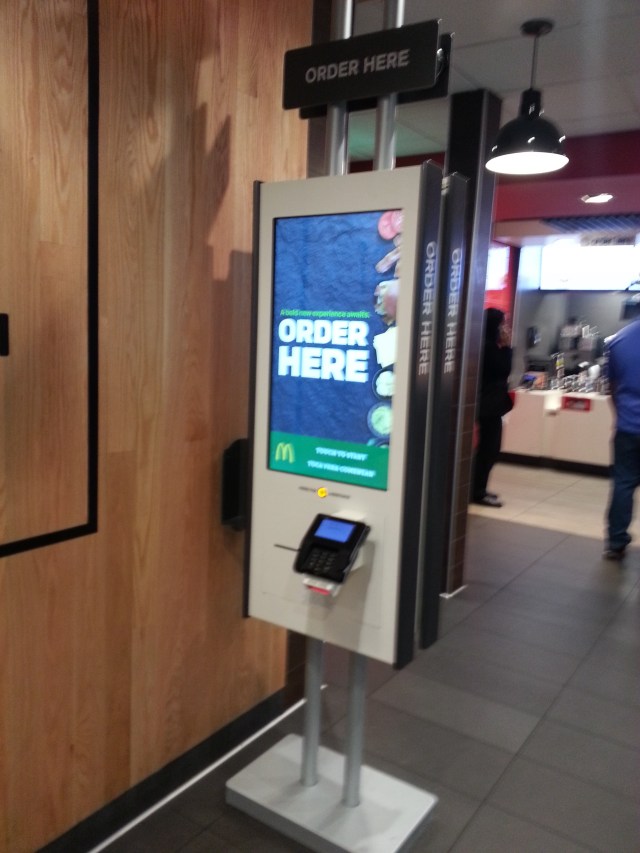
mcdonalds-kiosk

Fast food is in the crosshairs, and the industry is very nervous. Everyone wants something from fast food. Most customers want quick service, often 24-hour service,  from happy and enthusiastic workers. Foodies want higher quality ingredients and new menu items. Parents want “clean” and “natural” food for their children. Most customers want the prices low that define fast food. What does the Fast Food industry want? They want to meet  all of these goals and find a way to pay for an increase in the minimum wage. Shall we dive right in and see how happy our future meals will be?

Typically, when the economy is good and income rises, families spend more money on food. For fast food customers, that means ordering fewer items from the value menu or moving upscale to a different restaurant, perhaps moving from fast food to full service. Fast food tries to keep up with these trends but often fails. McDonald’s, for example, has tried adding steak and even lobster, but customers always return to burgers and fries. Customers may switch from burgers to steak, but not a steak from McDonald’s.

All day breakfast is McDonald’s latest food innovation, and it seems to be working. Breakfast items usually cost less but are still quite profitable. However, offering two meals at the same time requires quite a bit of engineering genius, since even fries and hash browns are cooked in slightly different ways. The same is true of burger vs. eggs, and hamburger buns vs. english muffins. Changing settings on deep fryers and other equipment slows the kitchen. McDonald’s may revolutionize breakfast, but every new option comes at a cost.

Seemingly minor tweaks can have surprisingly high costs. The “clean” and “natural” trend is focused on items like… eggs. Customers have started to demand cage-free eggs. However, few customers understand that moving away from caged chickens requires extensive changes to the entire egg industry. Because the “cage free” movement is also happening in supermarkets, this double squeeze is creating high demand for cage-free eggs. The egg industry needs 10 years to change to cage-free, but to meet all commitments, it has to be done in just 2 years. That’s a classic formula for expensive eggs and “counterfeit” cage-free products. Removing preservatives, artificial coloring, antibiotics and other ingredients will similarly increase costs.

McDonalds, by far the largest of the fast food chains, consistently ranks lowest in customer service surveys. McDonald’s usually gets top ranking for breakfast items and fries, but when it comes to worker attitudes, queue times, order errors, special orders, addressing customer issue…  they rank at or near the bottom. There is a solution that can address customer service problems AND offset most of these new costs and customer demands. But before we look at solutions, let’s understand the problems.   

At a typical McDonalds or any similar establishment, there is a front counter with 5 or 6 (or more) cash registers. Customers pile-up by the counter as they wait to place their order, and then they wander around awkwardly in this “pile-up” (or at the edges) waiting to grab their finished order. When it’s slow, not all cash registers are manned. When it’s busy, workers mysteriously disappear from the cash register. When crowds are small, it’s easy to know which is “your” register. When the pile is 5 deep or more, you just following the customer in front of you… to an empty register. Should you jump to the left, to the right or wait until someone returns? The next step you take is almost assured to irritate some customer (or some customer will irritate you). Fast Food means you’ve got to be fast too, and a special order makes everyone grumble.

If you want a worker that is always consistent, never gets tired or flustered, can’t be irritated, is never angry… doesn’t that describe a robot? Interestingly, while McDonald’s does have at least one fully automated restaurant, the CEO of McDonalds (Steve Easterbrook) said that there are no plans to replace workers with robots if the minimum wage rises to $15. Of course, the former CEO of McDonalds (Ed Rensi) said that it made more financial sense to buy a robot than pay $15 per hour for a human being to bag french fries. Hmmm… that’s is a bit confusing.

What’s even more confusing is that in New York City and other locations, McDonald’s has rolled out walk-up robotic kiosks at McDonalds that let you place your order. With a robot. You can still go to the front counter, but the kiosks take your order and keep you out of the “pile-up” by the counter. Apparently, these robots don’t replace counter staff, they merely allow you to “create your own taste”, by requesting a special order. However, the kiosks take your complete order, not just special orders. Each restaurant typically installs 6 to 8 kiosks, which provides enough coverage to take all of the orders that are currently handled by counter workers.

Looking at these kiosks, they will definitely improve service. You have a much better chance of getting a Big Mac without pickles with a robot than with the counter workers. The robots will never get tired and cranky, or irritate you by paying attention to another customer or co-worker. Even if every kiosk does not turn on every feature on day one, in tourist heavy areas, these and similar kiosks can communicate in multiple languages. That’s not only a great “free” feature, but it is something that you just can’t “turn on” with human workers!

McDonald’s already has kiosks in 2,000 restaurants and is now headed towards a massive rollout. Wendy’s has introduced similar kiosks and expects many of their 6,000 franchise operators to adopt them by the end of 2016. Panera has done likewise and expects to have kiosks in all of its locations in a year or two. At Panera, customers place up to 60% of their orders via kiosk.

The kiosk trend has moved into full-service restaurants like Olive Garden and Chili’s. Here, the kiosk is a tablet that stays on your table. You can order what you want, add items to your order, add a coffee or request a refill of your soda and pay for your meal. All without that often difficult problem of getting the waitstaff’s attention when it’s busy. That little bit of extra difficulty means that dessert doesn’t get ordered, customers skip that extra side-dish and revenue walks out the door. These table top tablets improve customer satisfaction, lower operating costs and may generate additional revenue.    

As the economy improves a higher minimum wage is inevitable. The new wage may not be $15 per hour, but it will be higher than it is today. Service and performance problems could be handled by hiring staff that is more proficient at certain tasks. But more requirements means higher pay and cost for testing and training. That makes this staff even more expensive than a robotic replacement.

Robots are headed to a restaurant near you, but probably not too a family owned restaurant. Not for a while. Robot suppliers and consultants will work best with big chain restaurants. Family owned operations will be late adopters. Besides, while big chains may have a technological advantage in serving up your breakfast order, old fashioned, slow paced human waitstaff may be an important differentiator for mom and pop restaurants.

Something similar happened with bookstores 25 years ago. Barnes and Noble and other regional bookstores chains went national and undercut the prices in small bookstores. Half of America’s small bookstores were wiped out. But a decade later, book buyers realized how much they  liked the traditional small bookstore experience. After that, the small bookstore returned, although in more recent years the ebook has challenged the small bookstore, AGAIN. It’s hard to say if the human touch will save family owned restaurants, but in a few more years the experience you get from a typical small restaurant and a super automated fast food restaurant will be larger and clearer.

One thing that is already abundantly clear, is that the 3.6 million fast food jobs today will shrink dramatically over the next few years. By 2020, as many as 2 million of these jobs will be  automated. After 2020, a robot arm to hand completed orders to customers, more automated kitchen equipment, and soda machines operated by customers will eat away at employment until it drops below one million workers.

We want a lot from our fast food. If the robot revolution overtakes McDonald’s and other big chains, they can afford to provide the better ingredients we want while finally tackling their most intractable customer service problems. Customers say they want fast food workers to be treated fairly and be well paid, but is that your top concern when we’re waiting in the pile-up? Even though the economy is improving and customer tastes are moving upscale, a lot of families depend on the value menu and will strongly resist price increases.

The robots moved slowly into place and now they are on our tables and in our favorite fast food hangouts. Deep down, we want more robots. When you order your McBreakfast, you want your coffee now and then you want to get out. Few of us bother to make any connection with the people who work hard… VERY hard.. to meet our expectations. But we want what we want, and we want it the same every time. We don’t want excuses that people are out sick or late because of the weather. We want superior service from the first minute a worker arrives until their last hour of overtime. We say we want workers to be well treated, but we mean we want robots. Which is exactly what we’re going to get. And that my Niccolls worth for today!


Posted in Best Practices, Delivering Services, Employment, Improvement, Continuous or Not, Robots, Uncategorized | Tagged , , | Leave a comment

Adidas’ SpeedFactory: A Big Step Towards Onshoring Work?


adidas-training-shoes

For years we’ve talked about a robot revolution, but robots are nothing new! Robots have worked in factories for decades. They’re incredibly fast, but they’re also expensive to program, and they can only follow very specific instructions. If they receive a tray of bolts, each bolt has to point in the same direction, if not the robot gets hopelessly confused. Whole factories were often redesigned before the robots could arrive. The new generation of robots can be dropped into the existing workplace and left to figure out little inconsistencies. Instead of being programmed, they learn from  mistakes (which costs less). New robots are arriving… somewhere near you!   

The gold standard for factory automation is “lights-out” manufacturing, which is complete automation with zero on-site humans. The first lights-out factory was built in 2001 by FANUC, a Japanese robotics firm. Other full lights-out factories exist, but the technology has only recently become cost effective and robust. Still, a lot of progress has been made since 2001.

The most advanced factories in the world have become automation incubators, where factory managers and automation technologists are learning the best practices for automation. Factories have multiple production lines, with each line producing a part or a complete product. While lights-out factories are rare, individual production lines in factories across the world have increasingly been totally automated.

By just looking at a factory, the signs of automation are not always obvious. Automated factories have few if any workers, which means that parking lots, the cafeteria, locker rooms, bathrooms and other facilities are gone. Without human beings, the factory floor is much smaller and more compact, hallways, reception areas, staircases, elevators, and other areas are much smaller. Even the heating and air-conditioning systems are much smaller.  All of this leads to a smaller, less expensive factory.

Like any big “disruption”, a few lights-out factories may be built in the next few years… the technology is certainly there… but it is the modest innovations that move technology forward. One of these steps is the SpeedFactory. Adidas, the global athletic wear company, has put one and one together and got three. By making a highly automated, but not quite lights-out, factory for athletic shoes, a series of other benefits suddenly materialize.

A SpeedFactory is a highly automated factory with a dramatically lower cost of operation, that is built onshore (where customers live). The combination of reduced staffing costs and reduction/elimination of transportation costs generates a third benefit, the ability to quickly provide products to customers. The lower cost of operation allows them to build the factory onshore, which further reduces the cost of operation by eliminating transportation cost, which gets  the product to the customer faster because the product is already nearby.

That speed difference is not just a convenience factor, it leads to more sales. Athletic shoes, consumer electronics, fashion items and many other goods either changes models quickly or change seasonally. When new products are released, some specific model, or option, or color is usually in higher demand than expected. That means it will be sold out, and restocking could take weeks or longer. Unless you just happen to have a factory nearby that can restock. SpeedFactories reduce restocking times and reduce the number of times a customer buys a competing product.    

Adidas has already built a SpeedFactory in Germany, and another one outside of Atlanta Georgia will be completed before the end of 2016. We have reached a tipping point, where manufacturers can move manufacturing back to America. Every manufacturing situation has different economics, but if manufacturing shoes and clothing can be onshored, then so too will many other manufactured goods.

Even if we only look at athletic footwear, Adidas’ has a lot of competitors: Nike, Puma, Converse, New Balance, Fila, Asics, Skechers, to name a few. That’s going to be a lot of new factories being built in America and Europe. Expand that out to electronics, and other industries, and we may see a big uptick in factory construction. That’s the good news. But the other news, not quite bad. But not particularly good either, is that while factory work will return to America, that won’t translate into many new factory jobs.  

No matter how many SpeedFactories are built we’re not going to return to the high of 240,000 shoe industry workers we had in 1966. Still, with just 2,000 shoe workers in 2014, an improvement would be welcome.

While SpeedFactories may not provide much employment, they do provide consumer benefits. No matter how great a range of products we have, consumers always want something unique. Customized athletic shoes are becoming big business. Customers can request mix and match pattern, different colored soles, laces, eyelets, and various finishes. Shoes can even be printed with selected graphics or something you designed yourself, for a completely one-of-a-kind shoe.

In lower Manhattan, Converse has a shoe store that is also a factory, creating custom sneakers while you wait! This is a tempting model for any fashion store. Using a small warehouse of custom parts plus printing machines to create exactly the product you want. A smaller version of SpeedFactory technology could operate in department stores and malls for a custom purchase experience. Not that long ago it was a revolutionary idea that you could get your eyes examined and pick up your eyeglasses just an hour later. SpeedFactories technology could be applied to a lot of consumer goods. More options, less waiting. That’s a great deal!    

While the SpeedFactory may revolutionize 21st century manufacturing, it’s not the first time manufacturing was “re-shored” to America. In the 1990’s, imported cars were rapidly gaining share in the US car market. Soon, imported cars ran into import limits and tariffs. The solution was to build foreign cars on US soil (Kentucky, Ohio, Indiana) and thereby be exempted from import limits and tariffs. The cost mechanisms were slightly different, but moving onshore changed the game for car manufacturers, and brought jobs back to the US.  

Which raises a rather large question. What happens to the jobs in offshore locations? As more work moves back onshore, jobs that were relocated offshore will go away. At the same time, the work replacing technology used in SpeedFactories and lights-out factories will become the standard for new factories, wherever they are built.

With over 100 million manufacturing workers, China is the world’s manufacturer. Yet, the technology that makes the SpeedFactory possible will make it very difficult to maintain this title. Employment in China will be squeezed on one side by jobs lost to onshoring, and squeezed on the other side by competitive pressures to automate Chinese-owned factories. There are stories everywhere about how robots will soon take over half more of the world’s jobs. But in China, that will happen even faster, because they will lose domestic jobs to automation, plus they will lose previously offshored jobs that return to the US and Europe.

In most developed nations, the ebb and flow of jobs due to automation and on/off-shoring is largely a corporate matter, and corporations have closely followed profit incentives. China, however, is a bit different. China is one of the few remaining Communist governments, and they see full employment as their primary tool to maintain political stability. Corporations in China exist to provide jobs. Yet, there has never been a Communist nation with so Capitalistic an interest in profits as China. When the squeeze comes, what will China do?

The answer comes in two parts. Part one, China will aggressively pursue new markets, both for domestic manufacturing and for outsourcing, to replace lost jobs. That means taking over work from Vietnam, Cambodia, Thailand and other low-wage manufacturing markets. As automation raises productivity, China will be able to underbid competitors. At the high end, China will push outsourcing services into high-end knowledge work (especially in banking, insurance, and financial), while simultaneously expanding the footprint of Chinese-owned banks and insurance companies.

Part two, China will open factories in America and Europe. Just as car manufacturers moved to America when the financial incentives were right, the lower cost of new automation plus the elimination of transportation fees provide powerful incentives for China to co-locate factories where products are sold. Within this answer is a second question. When Chinese outsourcing programs are shut down, will China offer to re-shore these services themselves, in order to keep their clients?

The technology that makes SpeedFactories possible will disrupt both traditional manufacturing and outsourcing. Consumers will greatly benefit from these new factories. America will gain a few jobs, perhaps more that a little additional taxes when a wave of new automated factories are built in the US. China, however, has the most to lose as worldwide employment in manufacturing plunges. However, we have seen that China has been flexible in moving from one area of employment to another and the people of China no longer wants assembly line jobs.

In the short term, at least, the consumer will be the big winner. More choices and continually lower prices. In the long term? There are so many disruptors that we can expect to hit in the next few years that it’s difficult to say anything other than, “Everything is about to change!”. That’s my Niccolls worth for today, and I’m sticking with it!

Posted in Best Practices, Improvement, Robots, Uncategorized | Tagged , , , , | 4 Comments