Will Corporations Still Need MBA’s?


MBA GraduatesAutomation is all around us. Technologies that displace human have become pervasive, and so SUCCESSFUL, that we barely notice them. Parking meters were part of the urban landscape for nearly a century, with downtown areas packed these mechanical marvels. Today a single automated “station” manages parking spaces for the entire block. Coins are gone, and you pay with a credit card. You probably never noticed them, but an invisible army of “coin collectors” quietly collected coins from meters, and then just as quietly disappeared as card swipes replaced coins and tokens.

Soon, card readers will disappear as payment stations and kiosks are replaced by smartphone apps. Coin collectors and many other nearly invisible workers have disappeared, but few tears have been shed for these low level, low paying and… let’s face it… boring jobs. High-end jobs that require education, experience, and critical thinking have been safe from automation, but not for much longer!

The reality is that high paying jobs are being targeted for replacement by the latest generation of robots and learning systems. In the last wave of US job losses, outsourcing and automation worked together to reduce the number of service and support positions. Many of these jobs were performed by individuals who spent months or years learning how to perform their jobs, but which nonetheless were repetitive and followed simple rules.

Outsourcers learned how to document the procedures needed to accomplish the work, and then transferred this knowledge to new staff offshore, or created software applications that performed some or all of the work. While we believe that this process of identifying, automating and moving work is a new challenge to the job market, it is, in fact, a process that has been going on in America for at least two centuries. Using knowledge transfer to move that work to machines or to a cheaper labor market has only recently been called “outsourcing”, “workforce augmentation” and “transformation”. We used to just call it, “progress”.

PROGRESS?: From just before the Civil war until the start of the 20th century, America’s economy was agricultural. Human and animal muscles tamed the land. The age of mechanization replaced human muscle with machine power, such as tractors and harvesters. Plow horses have completely disappeared, and computers are now part of modern farming. A century of progress in agriculture has resulted in just 1-2% of Americans working on farms. Farming jobs were replaced by factory jobs.
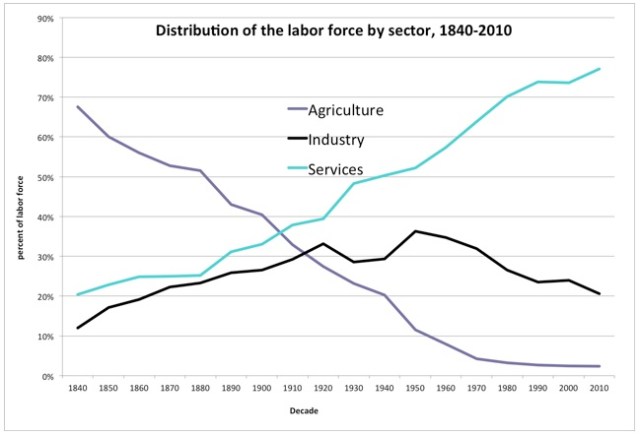
Employment StatisticsBy 1965, 53% of Americans were employed in factories. For most of America, especially southern states, this progress meant a better standard of living and kick-started the next economic revolution… the service economy. But as the service economy rose, history repeated itself as employment in manufacturing was hollowed out by automation (and outsourcing). Factory workers are now just 8% of the workforce, and will eventually settle in at the same 1-2% as agriculture. Now the service economy is evolving into the data economy, and old service jobs are being outsourced and automated.

This last wave of outsourcing, at the start of the 21st century, was driven by the falling costs of telecommunications and computers. Low cost allowed all corporate workers to have computers. Telecommunications became equally inexpensive, allowing computers all over the world to be linked together, making it possible for computer work computer to be performed anywhere. Including locations where the cost of labor was much, much lower. The Internet cheaply connected the world and made virtual offices around the world practical and easy to implement.

THE OUTSOURCING ENGINE: Now that all of these locations and computers were linked through the global Internet, an “outsourcing engine” was forming. With high-cost jobs at one end and low-cost labor markets and automation at the other end, the difference or gradient between the two sides would draw jobs from the high end and move it to the low end. The greater the gradient the stronger the draw and the faster the jobs move. At first, work moved from cities to suburbs, then from Northern states to Southern states, and eventually from the US to offshore.

This vast outsourcing engine has continued to grow and gain sophistication, moving millions of jobs offshore. Once core functions of specific positions were understood, outsourcers would look for their next opportunity. Outsourcers learned how to perform vertical drilling into onshore jobs… expanding successful outsourcing programs into: related positions, more senior positions, equivalent positions in different firms, similar positions in different industries, etc. Six Sigma, Lean and Continuous Improvement techniques standardized and simplified work, and new layers of software boosted productivity. Outsourcers talk about this ongoing churning of the outsourcing engine as the “new normal”. Tomorrow’s outsourcing will be very much like today, just bigger.

Until recently, the outsourcing engine appeared to be slowing. A lot of positions have been moved, and wages have been rising at the other end of the engine, reducing the “gradient” and slowing the engine. Cambodia and Vietnam have started to compete with “expensive” China, charging only 15% to 30% of the rates China charges. Knowledge work has moved from India’s big cities to the suburbs, and to other Asian locations.  But nothing slows down outsourcing for long.

THE ROBOT REVOLUTION: The outsourcing engine will continue to expand, and is about to go into high gear with a new breakthrough. In the second decade of the 21st century, a new generation of robots is arriving. True robots and thinking machines that are able to learn from experience and develop answers and ideas that they were not developed by their programmers. These are the grandchildren of automation. Some can even write their own programming and fix programming bugs. Through a new technology called Natural Language Programming, they know how to read and write. Machines that can read and write, that can learn from their mistakes have many of the same attributes as the individuals who work in corporate America’s most highly paid jobs.

New robots learn their work by working with an expert. An expert might send an example of a report to a robot. The robot will read the report, determine where the information in the report came from, learn how to imitate the “voice” of the document (i.e. the Wall Street Journal has a different language pattern than a Dr. Seuss book), and other logic that defines the document. It then creates a new report and provides it to the expert, who then returns it to the robot with corrections. This cycle repeats until the work is acceptable. This is the same process that a human, especially a trainee, follows when they learn how to perform their job.

PROGRAMMING vs. LEARNING: There are, however, differences between robots and humans. A human might be given a week to complete a complex project, and then many additional projects to gain expertise in this function. That takes months or years. A robot will complete the first report in a few minutes (eventually seconds). While the robot will be fast, the training cycle will initially be slow because the human expert needs time to analyze results and select new work to refine and build the robot’s capabilities.

Once a single robot learns how to perform a job, the training cycle is eliminated for all future robots. Instead, you just copy the programming… the learning… that he robot developed. All new robots will know the same things and act exactly the same way as every other robot. Robots have no egos to manage or divas to work with. Robots have no special needs and no after work interests to compete with. Every new robot worker is as good as the best worker you’ve ever had, and all robots automatically share new data and best practices with every other worker.
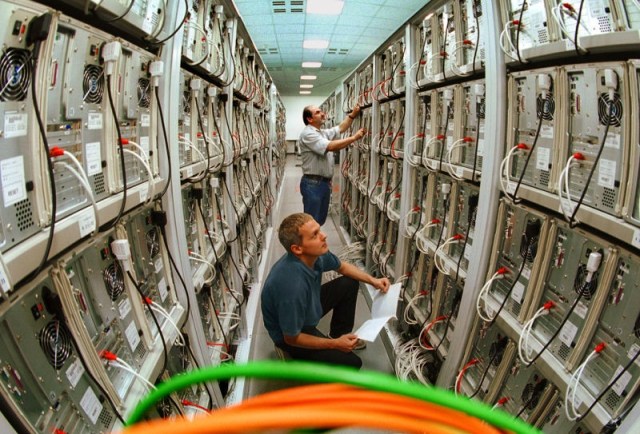
Computer support

Given time, new technologies create new jobs

Consider the magnitude of changes that robotic workers will bring. When corporations needed computers, they also needed computer support and programmers. It took decades for colleges and corporate HR to catch up. Training departments had to be created to ensure that skills were kept current and corporations could use the latest programming languages and technology.  As the number and the size of programming teams grew, managers had to be trained in managing and developing teams and needed to follow HR directives on how to rate performance and award bonuses. Recruiting, training, and other functions would go away. New “workers” don’t need new training teams. The quality of your staff continually rises, and the cost of new robots continually falls. Perhaps most importantly, the techniques and skills developed by the robots belong to the corporation and not the worker. Today, workers who learn more get paid more. Those that are the very best, get bigger bonuses. If they win industry awards, that person (or the entire team) will demand raises and promotions. Robots don’t make demands.

When will this new technology connect to the outsourcing engine? It’s happening right now. The earliest of these learning systems started in the legal field. Corporate lawsuits involve a massive number of documents, sometimes in the millions. The process of onboarding a large number of lawyers and determining which document are relevant to the lawsuit is called a document review. A big case could involve hundreds of lawyers reading every document, taking months or years to complete the review.

BETTER, FASTER, CHEAPER: Alternatively, if you just load these files into a database, robotic document review software can take the criteria for the documents needed for the case, go through a quick learning period (a few days) and then review millions of document in a matter of hours, if not minutes. The process of learning the rules to a document review (or any other task) is called NLP, or Natural Language Programming. Basically, the expert (in this case the head of the review) shows the review system some sample documents that look like what they want. The robot identifies some documents, and after a bit of back and forth, the robot reliably identifies the right documents.

NLP is just the latest in a long line of technical advancements in document review, but if it is fully utilized the cost of a review would be conservatively reduced by 50%-75% and the turnaround time would be dramatically reduced.

Advanced general purpose learning systems that use NLP are appearing everywhere.  Cars are becoming autonomous. Autonomous cars drive themselves. Most of the high-end cars sold in 2016 will have some or all of the features of autonomy. It may be another year or two before they use the term “fully autonomous”, but drivers will start handing over control of their cars this year. Who wouldn’t enjoy taking their eyes off the road in a traffic jam?

Driving a car may is not directly related to many corporate jobs, but when millions of robots start talking to each other to learn new driving rules, understand laws in different states, and adjust to changing weather conditions… learning machines will evolve at lightning speed.

Newspapers and text media have used robot reporters to write sports stories, financial updates, and other materials. Robots have autonomously performed surgery, and even independently performed research studies. Robots that can learn and adapt have arrived.

INSERT ROBOT HERE: To determine where these robots will work, let’s look at how outsourcers identify and prioritize projects. First they analyze a corporation to identify jobs that are performed by many people, even if the positions have different names. Next they look at the current cost and the replacement cost (offshore or automated). If these first two criteria yield compelling numbers, then you would choose the simplest of these positions to transfer. An entry level position instead of a senior position, or if there are many similar positions, the one that is the best documented. You will still need to add documentation, work out processes and identify tacit knowledge that is always overlooked, but good documentation gives you a good head start.
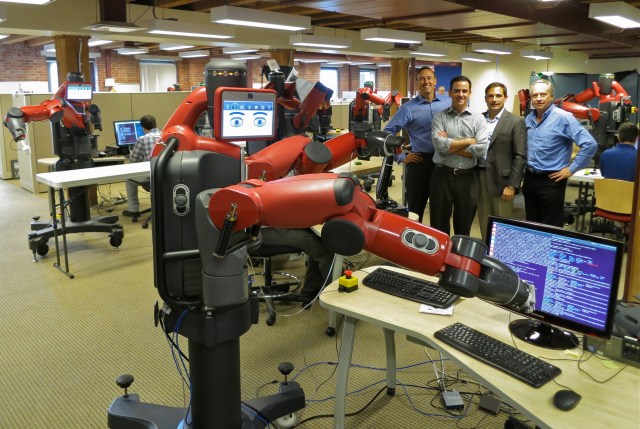
Robot Working

Does a financial analyst even need arms?

In the coming robotic revolution, the best place to start (entry level, well documented, and high paying) will be the positions filled by graduate MBA’s. Graduates with MBA’s and professional degrees (lawyers, doctors, accountants, consultants, etc.) have built their own “onboarding engine”. Just as outsourcing has an engine that is pumping jobs offshore, these professional schools have an engine that pumps graduate students into corporations. For many decades, corporations work directly with professional schools to ensure that their graduates fit into “development tracks” in the corporation.

For example, business colleges graduate MBA’s that are trained to become financial analysts. MBA programs train to the skills that their corporate customers want. Corporations go to their favorite campuses to recruit. New MBA programs are constantly looking for ways to tweak their program to get included in these recruiting efforts. The “onboarding engine” is already connected to one part of the corporation, while the “outsourcing engine” is connected to other areas of the corporation.

Once the outsourcing engine is upgraded with the right robotics to financial analysts work, you just need to let the two engines connect. In a couple of years, we can expect the first entry level MBA robot. At first, it will support, then replace many of the entry level MBA’s. Then it will start to move up the value chain to more and more senior versions of these jobs. Once the first robot is ready for any job description, it can be replicated across the entire army of robot “knowledge workers”. Within the next 5 years, we can expect that much if not all of the work that is done by rooms full of MBA’s can be performed by robotic learning machines.

HOW HIGH CAN YOU COUNT: How many jobs will be affected? Just as with farming and manufacturing, it takes time to go from the 1st robot until the field has matured. Farming took a century, and manufacturing took half that time. The last wave of service outsourcing took about 20 years. So, we should expect the move to a data economy will happen in 10 or 12 years, and it will pass the half way mark in 5 years or less. How many jobs will be affected?  Keep in mind that when MBA graduate jobs go away, so too will jobs in HR and training. When the number of MBA’s shrinks, so too will the number of administrators and other support personnel. Conservatively, 60 million jobs (40% of US jobs) will be impacted, with some jobs permanently disappearing and others evolving into new positions.

Whew! We started with collecting coins from parking meters and we end with a devastating tidal wave of change that will sweep away some of the highest paying jobs today. You may think that this is a fantastic scenario, yet you can draw a straight line from farms, to factories, to service firms and follow it to our data economy and modern knowledge work. The only variable that changes is the speed at which each of these stages transfers transfer jobs. Of course, in the last stage jobs were largely transferred offshore and in the next stage work will be transferred to robots and away from humans.

Past pundits have said that we’ve reached the end of outsourcing. And then something a bit more complex is outsourced, or a new (lower cost)location become an outsourcing hotspot. In this coming wave, so much of the groundwork is already complete, and the technology is capable of moving so much faster, that outsourcing will cause many times the disruption that we have seen so far. Get ready for a rough ride as robots replace MBA’s in corporations around the world. But don’t worry, that doesn’t mean that America’s most privileged graduates will be unemployed. In our next blog, say “Hello!” to the Creative Economy! At least, that’s my Niccolls worth for today!

Posted in Employment, Improvement, Robots, Unique Ideas | Tagged , , , , | Leave a comment

The UBER Agenda & The New Transportation Economy


UBER Protest

All Rights: NBC

If you are a regular reader, you know that I often write about automation and Robotics. Lately, I have been writing about the coming robot revolution, which is closer than you think. It’s also going to be a lot bigger than you’ve heard. You may have lived through other revolutions in employment, but the robot revolution will be so quick and so wide-spread that it will be, well, revolutionary! Today, we’re going to peel back the many layers of the robot revolution to see how it will add up to a Tsunami of economic change. Let’s dive into the UBER agenda, and see how just one stream in the robot revolution will shape our future!

By now every reader has heard of UBER… the ride-sharing company… even if they haven’t taken a ride with UBER. The UBER agenda is to see that everyone uses UBER, all the time. If you live in a big city, you’ve either used UBER or seen others tapping on their smart phones while they wait for their UBER car. UBER says that they are not a taxi service. Instead, they categorize themselves as a service provider, producing software for taxi and private car companies. However, their drivers… and increasingly the courts… are saying that UBER is a taxi service. Why does this distinction matter? Because if UBER is a taxi service, then the drivers are UBER employees. Their drivers are suing UBER for missing wages and benefits. UBER has realized that the greatest threat to their future profitability is not the growing competition in ride-sharing, it is the economic consequences of being classified as a taxi service.

UBER has been addressing this risk in two ways. First, it is branching out into other transportation roles, delivering packages and cargo as well as moving passengers. Over time, they plan on dominating every profitable function for moving people or things from one place to another. UBER has experimented with hybridized service that blend taxi and messenger services. Sophisticated software can predict traffic, time to complete a passenger ride and other data to efficiently blend passenger rides and package deliveries. If they are very efficient, UBER will deliver industry disrupting efficiencies to car services and package delivery (FedEx, DLS, UPS, etc.). UBER has similar plans for the trucking industry. While UBER tunnels into these industries, it is also focusing on a rapid replacement of human drivers. No human drivers means: lower operating costs, no employees lawsuits, and the ability for their vehicles to wait for a passenger without adding costs. You’ll see how that last item may be the biggest disrupter of all. Let’s break this down, and put some numbers around UBER’s plans.

UBER Taxis

All Rights: MSNBC

Taxi Drivers: UBER is making big investments in robotics. It has already bought out Carnegie Mellon’s robotics department and is gobbling up other firms with similar capabilities. But UBER doesn’t have to be the first company to develop a fully autonomous car. All it has to do is buy one. All of the major car manufacturers are releasing semi-autonomous driving features. TESLA’s high-end cars now have Auto-Pilot, which is a robot car in all but name. TESLA expects to release their fully autonomous car in 3 years. Between the car industry and UBER’s own customizations, the UBER self-driving car could hit the road in just 3-4 years. Then UBER will begin their big push to replace drivers. Within a few years, they could replace most of the 275,000 taxi and private car drivers in the US. That’s a lot of jobs, but the US has a big economy, and we should be able to easily absorb this change. But what about…


Other Transportation: The same software that can drive a taxi can drive the trucks that deliver cargo around the country. If trucks can be autonomous, so can buses and trains. Recent deadly accidents have been attributed to “human error”, leading to questions about why the government hasn’t mandated automated safety features, or have computers handle driving in accident prone areas. Whether it’s all at once, or in bits and pieces, the 4.5 million jobs in the transportation industry are on the verge of being replaced by autonomous cars, trucks, and trains. Planes aren’t that much farther behind. If these vehicles were autonomous, how would our lives change?

For one thing, all of these vehicles would communicate with each other. Your car would know what other cars are doing before they did it. Cars would act cooperatively. Traffic jams would fade away as software routed traffic around accidents and jams, which acting cooperatively at the site of the jam, allowing it to clear more quickly. Autonomous cars would even let emergency vehicles get to accident sites more quickly. Eventually, cooperative cars would virtually eliminate accidents. That’s a good thing, isn’t it?

Accidents: Cars accidents happen all the time. At least, they do when fallible humans are at the wheel. If fully autonomous cars arrive in 3 years, then they will become popular in the next 5-6 years and may dominate the roads in as little as 8-10 years. Over that time, accidents will drop, as: road rage, drunk driving, distracted driving, and drivers falling asleep at the wheel no longer contribute to traffic accidents.

Traffic Deaths

All Rights: Wikipedia

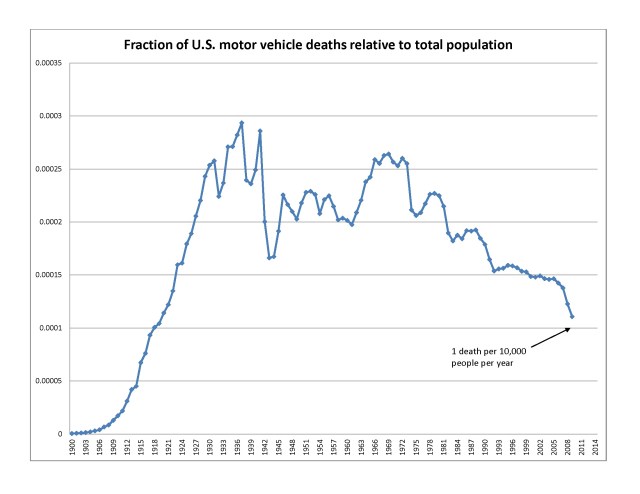
Today, approximately 1 million car accidents happen every year, involving 4 million people, that results in 35,000 deaths. As you can see from the chart above, basic car safety innovations (seat belts, safety glass, airbags, etc.)  have dramatically reduced the number of fatal car accidents. IN the future, there will still be the occasional unavoidable accident, but 99% of today’s deaths and injuries will go away. A 2010 analysis placed the annual cost of traffic accidents to the US economy at $836 billion.

Insurance: If you watch a few auto insurance commercials or read a few ads, you will notice that car insurance is trying to get your premium more closely linked to your individual risk. If you prove you are less of a risk, you get a credit against the cost of insurance. For example, if you don’t have any accidents for a period of time, or if you are high risk because of previous DWI incidents you can install a “breathalizer” device to prevent you from driving while intoxicated. Newer carts have a “black box”, similar to the ones in airplanes, that has GPS tracking, speed, and directional data and can show patterns of erratic behavior (a driver falling asleep at the wheel?). If you don’t drive erratically, don’t speed, don’t drive while drinking, then your insurance costs less. Once there are many autonomous cars on the road, with robot drivers that almost never have a car accident, highly flawed human drivers suddenly become a major liability.

Not on day one of the robot revolution, but at some point, turning off the robot driver and taking the wheel yourself, becomes a staggering liability for your insurance company. And that cost has to be passed on to you! It’s not just that a human cause more accidents, it’s that a robot driver will be so safe that it becomes classified as a safety system (i.e. it saves lives). Consider a courtroom, not too far in the future, where a car owner just wanted to drive his own car for a while, but accidentally kills a child who was crossing the road. That happens all of the time on today’s roads. But if autonomous cars have a much better record of driving, then you are consciously raising your risk of an accident.

This may not just astronomically increase the cost of your insurance, it may void your insurance for as long as the car is being manually driven. Or, humans may drive so poorly (compared to robot cars) that if you turn off the robot, and you kill someone, it becomes murder in the 1st degree.  For civil cases where the damage is financial, trying off the robot may be considered reckless behavior, resulting in a much higher award to the injured party. Now, ask yourselves… how long after the 1st fully autonomous car is on the market before the first lawyer uses exactly this argument in court? Then, how long before human drivers are fired because the cost of insurance is prohibitive? Insurance companies will either stop selling to people drive their own car, or they will make it fantastically expensive. Once robot cars are available, older drivers, first-time drivers, those without perfect vision… may all be driven by insurance costs to turn the wheel over to the robots. For some of us, the robot revolution will arrive a bit sooner.

Let’s go just a little farther into the future. If insurance companies get their way, human drivers go away and traffic accidents virtually disappear. For a short time, profits at insurance companies will explode! Massive premiums and no payouts! But then, the cost of insurance will drop down to virtually nothing, and the auto insurance as we know it will disappear. There may still be some theft insurance, but in cities like New York, car theft is down 97%. The days of hot-wiring a car and driving away are gone. A robot that is smart enough to drive your car, can also drive away if someone tries to break in, and notify the police (with photos of the attempted crime and perpetrators). As the auto insurance industry fades away, we will also lose the 227,000 jobs it creates. Eventually, new forms of insurance may replace the old auto insurance, but it’s going to take years for this new market to develop.

Car Repairs: If today’s 1,000,000 car accidents go away, then a lot of garages and repair shops will close. Writers looking for an upside to the robot revolution tell us that by upgrading our educations, we may be able to thrive even after our existing jobs are taken over by robots. This could be a legitimate path for some lawyers, doctors, financial analysts and knowledge workers. It won’t be free. Adding another Masters or Ph.D., and giving up a few years of productive work time, will increase your lifetime debt by at least $1,000,000 to $200,000, depending on the school and the degree. That will get you to the next job, which might not pay any more than your last job. What about the 30% of the adult workforce that never attended college?

Car Crash

IBISworld: Oct. 2015

In order to cross the job gap to the next job that a robot can’t do (yet), lower skilled workers will be faced with a huge educational leap of faith. There are 115,000 gas stations in the US that provide nearly a million jobs. As cars become robotic, many will also become electric. Electric cars have fewer fluids and consumables than internal combustion. Electronic or not, automated cars are likely to be serviced by automated fueling stations. The next job for these displaced workers is unlikely to be in a higher end version of their old job. Adults that may have tried college and not done well, or tried and failed their board exams many years ago, will need a lot of support to make this journey. And when they get that new degree? If workers with Masters and PhDs are scrambling to find their next job, higher up in the educational hierarchy, working who have just earned their 1st college degree may find that the job they trained for has just been taken over by robots.

Doctors & Lawyers: No accidents means no injuries and no lawsuits. It’s hard to estimate how many jobs are generated by the 1,000,000 car accidents and 4,000,000 people who are involved in auto accidents. Many fender-benders cause no physical injury, but do require time off from work to deal with car repairs and traffic infractions. When the injuries are greater, there can be months away from work to recuperate. How many temporary workers replace these individuals? Think of the time, billable time, that is spent with doctors and medical professionals to treat injuries. And to develop documentation for a lawsuit. Ah yes! The lawyers. In additional to real injuries, there is $5 to $8 billion in fraudulent car accident and injury lawsuits every year. Even people that walk away from an accident with seemingly no injuries may have medical problems later in life.

Autonomous cars will wipe out a whole practice area for lawyers. That’s especially troubling because the legal profession has already been rocked by new forms of automation and by software “Bots”. Big corporations are demanding that law firms reduce their costs. The latest technology, a cousin to the self-learning autonomous car software, allows computers to look at lawyer created documents and produce the same work… contracts, document reviews, government forms, etc. In the medical field, however, we have the opposite problems. America has a shortage of doctors, nurses, and medical professionals. Once medical personnel are freed from dealing with car accident victims, will they help solve the problems in America’s health care system, or will they be attracted by lucrative niche areas, like plastic surgery?

Car Industry: Car manufacturing and car dealerships jointly provide over 2.7 million jobs. The average American family owns 1.9 cars. If the UBER agenda is achieved, all that changes. A typical family needs more than one car because: both parents may work and not have access to mass transit, the second car may be used by teen aged children, a stay at home parent needs to drive to activities for the children, etc. Now ask yourself, “What is the level of utilization for the second car?” Is it actively driven (don’t count parking and waiting times) for an hour a day? Maybe two hours. So, in a 24 hour day, the car is more than 90% unutilized?  Most families would be better off financially if they kept just one car and then ordered an UBER car for other tasks. If you’re running around a city to shop, you would save a huge amount of time finding parking spots. You just leave one UBER car, do your errands and then have another UBER car pick you up.


In an UBER world, there could be a temporary surge in car purchases as the world transitions to autonomous cars. Eventually the “forward facing driver” could be replaced by having all seats fact inward, so that passengers can interact with each other. We’ve already added stereo, DVD, LDC screens and WiFi to cars, why not put a table in the middle of the space and make it a living room. Or work-office on the road? When the “driver” no longer needs to face forward the entire car layout could, and will, be radically redesigned. We will not just replace cars as they age out, many American’s will “upgrade” their cars as new features are introduced. Think about how iPhone users stand in line every time a new phone is released (did I mention that Apple may be building an autonomous car?). After this surge in employment, we face a permanent decline in auto industry employment as families supplement their main car with an UBER contract for the rest of their car needs. Farther into the future, even a main car may seem like a waste of money, especially in cities where owning a car often means owning a garage space that costs as much as an apartment.

Of course, none of this is especially new for America’s car industry. The auto industry has been automating and downsizing for years. The auto industry practically invented outsourcing and Detroit… the long-time home of car manufacturing… has become a bankrupt city with a fraction of its old population. Old skilled positions, such as painters and welders, have been gone for decades. UBER will accelerate the trend in new and unexpected ways as they reduce the number of cars owned by the average American family one, or none. That will eliminate at least half of the traditional manufacturing and distributorship jobs. Let’s call it a conservative 1.5 million jobs.

Summary: Between lost jobs in the car and transportation industry, a permanent shrinking of Auto insurance and the elimination of car accidents (and related legal and medical work), 5 to 8 million jobs will permanently go away. And it could all happen in just 5 to 10 years. And that’s just the 1st round of changes. Make no mistake about it, the robot revolution will be one of the most important economic disruptors of the 21st century. New industries will eventually rise, but there may be a gap of years or decades between the fall of the old economy and the rise of the new economy. Will more education help us during this transition? Possibly, but this solution will not come cheaply. It means more years in school and probably another hundred thousand dollars in lost revenue and additional tuition costs. And for the individuals today without any college degrees, it’s going to be very difficult to transition to their next job when robots eliminate their current job.

That doesn’t mean that it’s all gloom and doom for employees. In fact, this economic transition is going to create a new industry… the creative economy! What is it and how does it work? We’ll take a deep dive into the new growth industry of the 21st century when we take another look at the coming robotic revolution! But that’s my Niccolls’ worth for today!

Posted in Uncategorized | Leave a comment

Why Do I Get Very Different Offers For My Small Business?


SOLDWhen you sell your business, you will talk to friends and mentors and ask for their opinions. You’ll want to know if they agree with your decisions. You’ll probably ask, “What do you think is my business worth?”  In a previous blog we saw that valuations are based on measurable financial data, and adjusted through a “multiplier” (that varies by industry). That, plus the value of your assets… if any…  provides a pretty straightforward valuation. Alternatively, you can find firms that are similar to your that were recently sold. But, when you look closer apparently similar firms sold for different prices. How can this happen? Aren’t valuations “scientific”, aren’t three formulas that are used to determine value? As you will see, there are formulas, but there is more to valuation than just financial data!

A good valuation combines art and science. We see this in large, global corporations. Firms with different fiscal years, using different national tax systems, dealing with different local issues, and using multiple currencies, somehow provide comparable information every year.

That doesn’t mean that they don’t have issues to overcome. Let’s say the UK office, which may be barely profitable, might appear to be doing very well just because the Euro went up. Or the reverse might happen when the Euro falls, deflating the UK contribution.  Determining “real” value in a global firm requires complicated analysis. Still, the formulas for valuation exist, and the bigger the firm the more financial data is available. Valuation, while complex, should at least be reliable. Right?

Let’s test that theory by looking at the market value (capitalization) of a publicly traded firm. The market capitalization is simply the number of shares of stock multiplied by the price of a share of stock… all public information. A firm with 1,000,000 shares of stock that sells for $10 a share is valued at $10,000,000. Simple!

How can anyone disagree with this? It so happens that most of Wall Street spends every day telling us that this valuation is wrong. Wall Street employs tens of thousands of financial analysts. Each analyst examines the same public information, but they often come to very different conclusions.

Could it be that some analysts have access to better information? After an analyst covers a firm for years, they probably develop relationships with that firm. They might have access to information on products before they are released, plans to make an executive hire, upcoming major lawsuits or other inside information that might change the value of a firm. That information could be incredibly valuable, but it would also be completely illegal.

Receiving or acting upon any information that has not been officially made public (also called “material non-public information”) is the definition of “Insider Trading”, a Federal offense. Government regulations make it very clear that publicly traded firms cannot provide inside information and financial firms cannot receive that information or take any actions based on it. It’s a level playing field, where everyone has the same information.

If everyone has the same information, analysts should have come to very similar… if not identical… valuations. One sign of how financial analysts value a firm is in their “Buy, Sell, Hold” recommendations. “Hold” means the market price is correct, “buy” means it’s too low and sell means the price is too high. Most analysts use a 5 tier system that goes something like: Strong Buy, Buy, Hold, Under Performing and Sell.

This may not show what an analyst thinks a firm is worth (that’s reported through other metrics), but shows if they agree that the firm is worth what the public is paying. Again, analysts all use the same publicly reported data, read the same market reports, follow the same rules of accounting, were trained using the same Corporate Finance textbook, and use virtually identical spreadsheet models.
I randomly picked IBM for our example.  This is a very well known, very well researched, publicly traded firm. The market capitalization (price) changes every day, but as of today, it is $135 billion. In the graph below we have recommendations from 16 analysts. Only half say that the price for IBM stock is correct (hold), the other half think the price is wrong (buy or sell).

IBM 3

Do Professional Analysts Agree?

Do the dissenters at least agree as a group that IBM is EITHER that it is over or under priced? Not at all! Six think the stock is under-priced and two think that the stock is overpriced. And everyone used the same information to develop their opinions. More complex mathematical question… how far away is the moon, what is the weight of Mount Everest, how many bricks are in the Great Wall of China… are answered with far greater consensus by experts in these field.

Ultimately, the “right price” for a business, is subjective. Two buyers may agree exactly on the price of a firm, today, but disagree how a change in the economy will impact the value tomorrow. In a previous article, we spoke about the “multiplier” that is used to determine value. The multiplier changes, depending on the industry.

Consider a staffing firm that staffs programmers. Your list of customers might be largely the same as one buyer, but may have open up many new accounts for another buyer. You might only have a single customer, which is usually a very big negative, but a buyer may want you specifically to get this one account. Likewise, IF software companies are valued at a higher multiple than consulting firms, an IT consulting firm that completely manages their own staff might be valued more like a software firm than a consulting firm. Especially if the buyer is a large software firm.

Unlike textbooks, the real world has exceptions and special cases. Valuation formulas provide a baseline, but the buyer is a very big part of the final offer. Your value is different for every Buyer you meet. In order to get the maximum value for your firm, you not only need to understand your firm, you need to understand the buyer’s firm and their motivation for buying.

When two firms have a good “fit” their combined value is the highest. Usually, not always but usually, buyers are aware of the fit. The buyer provides the seller financial and other information, so the buyer has an opportunity to understand the details of your business. However, the seller usually provides far less information. After all, you’re not paying the seller.

There’s no magic fix that will tell you how you will fit with another company. You just need to do the basics:

  1. Do some research. Has the buyer been in the news? Have they said anything about their plans?
  2. Look at the buyers website, the Linked-In profiles of the individuals you are negotiating with, and
  3. Have dinner with the buyers team. Not just the ones working on buying your firm, but operations and sales. Talk to them about what they need to accomplish and how you fit in.
  4. Speak to the buyers customers. They may be listed on their website, personal contacts may help or the buyer may direct you to customers who would be comfortable talking to you.

If you want the best price for your firm, you need to find the firm that fits best. And you need to know how to tell the tale of how your two firms are worth more together than apart. If you can’t identify and articulate this fit, you may get a good deal for your firm, but you may not get the best price. At least that’s my Niccolls worth for today.  Next? We’ll take a look at firms with a special “something” and what it’s worth!


Posted in Small Business, Uncategorized | Leave a comment

The Empire State Strikes Back!


Star Wars

All Rights: Lucasfilms

Don’t we just love rebels? Just look at the anticipation for that plucky new groups of rebels in the next installment of Star Wars! In real life, instead of an alliance of rebels fighting for our rights, we have market disruptors trying to change how we buy products and services. Do you make an electric car that people actually want to buy? Maybe you want to launch a startup that launches actual rockets into space? Or maybe you developed an online department store got rid of advertising to pay for free delivery… by DRONES? Now that’s a disruptor! But now, the disruptors are getting disrupted. This week, some of the most powerful disruptors, have been disrupted! What’s going on, is it merely a coincidence or is it just the disruptor’s feeling the power of the FORCE…  of governmental regulation?

I’m writing this on Singles day, the made-up holiday that is disrupting our revered, long established, made-up holidays. Like Black Friday and Cyber Monday. A few years ago, China in general and Alibaba in specific decided to make up its own excuse for a sale. Singles day (November 11… or 11-11). In 2014, on-line sales for Singles day ($9.3 billion) beat the combined Cyber Monday and Black Friday on-line sales ($4.2 Billion), even though most of the Singles Day sales were in China. Singles day for 2015 reached $14.3 billion. Will China’s fake holiday cannibalize America’s fake holidays? Well, here in New York we have struck the first blows against the disruptors! New York’s government Jedi’s want to look back to the past, to ancient days, when Taxi’s were yellow and fantasy football was something on a scrap of paper. Let’s take a closer look!

GAMBLING: Is fantasy football gambling? According to the Attorney General of New York, it is if you’re using one of the big disruptors, like Fanduel and Draft Kings! New York has a law that makes fantasy football legal. This exemption was granted because a season of matching up teams is an exercise in detailed statistics. However, when disruptors wanted to revolutionize fantasy football and crank up the excitement, with daily payouts, the Attorney General of New York said they crossed over from a game of skill to plain old gambling. Less reliance on math and more reliance on luck is pretty much the definition of gambling. The total amount of money in fantasy football is, according to Forbes, as much as $70 billion annually. It’s going to take a LOT of the Attorney General’s time to disrupt an industry that big!

FOOD: For years now, services like Grub Hub, Seamless web and Menu Pages have made it easier to order take out. Why dig around to find a menu, or to try remembering which restaurant has that dish that you love? Who could have imagined that these helpful services would lead to the dreaded… Ghost Restaurant!  What is a ghost restaurant? It is a fictional restaurant, listed at a real address, but which doesn’t actually exist. The “ghost”  could be a completely non-existent restaurant. That food you’re eating could have been made in someone’s home, and their kitchen would not have been inspected (the City‘s health inspectors never inspect home kitchens).

Central Perk

A “real” copy of a fake on “Friends”!

How can you tell? Basically, you can’t… unless you go to the listed address and see if there is a restaurant. After all, the food is delivered to you. If the bag has the right name on it, or if there is a printed menu, how do you know where it came from? Alternatively, there might be a restaurant at the address, but it has a different name. They could have just changed their name and haven’t changed the signs yet, or they could have failed their health inspection or have been hammered by bad Yelp! reviews. Using a new name (while still operating under the old name) is a way of ditching their bad reputation, and low scoring reviews, without changing anything.

The local news discovered this in New York. Now the disruptors are partnering with the NYC department of Health to verify that the restaurants they list are registered with the city.  The same scam is probably happening in your town! If you rely on these disruptors, make sure that they aren’t listing fake restaurants. Although it is ironic, that bad restaurants are relying on food disruptors because they have been called out another disruptor… the restaurant review site!

HOTELING: AIRbnb is the leader in temporary room rentals. In fact, they have been so successful in converting spare rooms into hotel space that they have come under the scrutiny of every major city government in America, as well as many overseas cities. Still, it is New York City with its big tourist and hotel industry, and it’s high rents, that has become ground zero for the battle with AIRbnb. They have been so successful at turning spare rooms and spare apartments into hotel space that neighborhoods with high AIRbnb use are seeing rising rents. And of course, hotels (which are regulated and taxed), are increasingly resisting the rise of this particular disruptor.

AIRbnb got started due to a Federal Tax loophole, that was created for the Master’s Golf Tournament. Lobbyists for the State of Georgia got a rule passed that allows you to rent a room for 15 days without your needing to report it as income. Since the golf course for the Masters is not in an urban area with a lot of hotels (i.e. it takes place in a beautiful, bucolic, wooded golf course) this makes some sense. Before room rentals were an organized industry, little income was reported. However, once you become a multi-billion industry (AIRbnb alone is valued at $50,000,000), regulators and competitors (such as traditional hotels) will catch up with you.

Regulations for “hoteling” vary from city to city and country to country. New York rules include: hotels can only be in areas zoned for hotels, hotels must have fire safety equipment and evacuation plans in every room, hotels have maximum occupancy rules. If you have a very expensive NYC apartment, you are not going to be happy that the apartment next door has 5 or 6 temporary tenants. You’re going to be even less happy if new tenants check in and out every ever few days. In some NY neighborhoods, small apartment buildings with 10 or fewer apartments might have two or three AIRbnb “hotel rooms”.  How does that affect the safety of the other tenants, and the value of their apartments?

Until recently, AIRbnb followed the lead of another major disruptor, UBER, in confronting local governments. Now they are being very cooperative. Cooperative disruptors? Well, their sudden cooperation might have something to do with the NY Attorney General’s report on AIRBNB, which found that 75% of the rooms they rent are illegal. Inside sources say that in early November, AIRbnb sent a letter to New York City to affirm their commitment to local laws; the day before, they sent emails to a number of their “landlords” to tell them that they were non-compliant, and all of their booking (some for months in advance) would be cancelled at Midnight. Did they notify the 75% identified by the Attorney General or just a token few? The lucky few that weren’t taken off of AIRbnb can now tell their guests that they will be charged additional taxes and fees, the same fees that the big hotels charge.

DRIVING: Since we mentioned UBER, they certainly deserve a few words as well. UBER IS perhaps the biggest, and loudest,  disruptor. There is, however, a little question of what they are disrupting. For you and me, UBER as a taxi service. UBER disagrees. They are vehement that they are not a taxi service, they are a software service… that just happens to be used by taxi’s and private car services. And they just happen to have a program to buy cars for their employees. Excuse me, not employees… software customers.  If they were employees, UBER would be responsible for paying benefits, ensuring that minimum wage laws were met and that they dealt with all lawsuits.

UBER does provide some insurance for the driver’s car, but it’s a complicated model. Because the UBER car is also the personal car of the driver, the insurance rules change during the day. When you use this car for personal reasons, the UBER insurance does not apply. Instead, your personal insurance is used. If you have the UBER software on and are waiting for a ride request, you have one level of insurance. When you are on the way to pick up a customer, or the customer is in your car, there is another level of insurance.

Insurance laws differ in every state, so your personal level of risk in an accident will vary. You could fix any insurance gaps by buying commercial insurance, but that is expensive and requires you to get a commercial driver’s license. That means that UBER is not just disrupting the Taxi industry, it is disrupting what it means for the passenger to use a car service.

UBER’s next disruptive move is to replace its drivers with self-driving cars… robots! Tesla just released “Autopilot”, their semi-autonomous car driving software. They expect to release the fully autonomous version in 2-3 years. Other car manufacturers are releasing similar features on their high-end cars. UBER has invested heavily in robotics and wants to be a robotics powerhouse. Why? Because if they replace the driver, they significantly reduce the cost of operation. Also, eliminating the driver frees up another seat in the car, allowing them to more cost-effectively launch a shared ride system (think mini-bus).

That’s a LOT of disruption.  With New York’s fleet of over 13 thousand yellow cabs and 6 thousand new green cabs (picking up passengers in the boroughs and upper Manhattan), and tens of thousands of full-time taxi drivers, the City’s government has plenty of reasons (safety, employment, politics) to oppose UBER.

Will all of the disruptors win? Maybe. Will every new disruptor create unexpected disruptions? Quite likely. Will the future of market disruption depend on how they follow the laws made by big cities? Almost surely! So, keep an eye out for these and other disruptors. They are going to change the way we buy everything from lunch to a hotel room, but even disruptors will learn that some of the rules they’re disrupting are there for some pretty good reasons. At least, that’s my Niccolls worth for today!
Posted in Small Business, Uncategorized | Leave a comment

What Is My Small Business Worth?


Price is Right

… or is it? What is the “right” price?

As a small business owner moves towards retirement, or they find that their company is “stuck” at a certain size, an owner may choose to sell their firm. Most entrepreneurs will only own one, possibly two businesses over the course of their life. When sales are decades apart, it’s difficult to know if the rules from the last sale will apply to the next one. It is especially difficult to know if the rules for determining the sale price still apply. If you have never  sold a business, arriving at a sales price can be a mysterious and difficult process. Today, we will demystify the process, and give practical tips on how to know the selling price of your business.

It is difficult to say exactly what any specific business is worth at any given time. The same business will have a different value at different points in time, even when the revenues are unchanged. A business that could sell for a million dollars today, might be worth fall less tomorrow if: the economy takes a downturn, the stock market crashes, the rate of interest rises, your biggest customer declares bankruptcy, or some global issues occurs. Even when your revenue is not directly impacted.

Big businesses, which are often publicly traded and have their financial data reported on the news or in businesses publications. Small businesses rarely make their financial data known, including the price their firms are sold for. The Small Business Administration (SBA), is the main Federal agency with jurisdiction over small businesses. However, the SBA doesn’t even have a specific count of the number of small businesses in America. The best data the SBA has is that there are between 23 and 25 million small businesses in operation in the US. Beyond that, information gets pretty spotty.

The best source of information for a quick idea of what your business is worth, and to find out if the market is going up or down is a private service called, BizBuySell.com. Their quarterly report provides financial information for businesses sold on their site.  BizBuySell is probably the biggest and best run site for the sale of small businesses. While the numbers on BizBuySell appear similar to deals that I have seen, their numbers may not be completely the same as deals consummated elsewhere.

For example, almost all of the postings on BisBuySell are placed by business brokers rather than by the business owners. BizBuySell is a digital marketplace, and that might mean that when small business owners do choose this site, they are younger entrepreneurs that are more comfortable with technology. Even so, the quarterly reports by BisBuySell are as good or better than any other data source for small business sales by geography and by industry. Your local chamber of commerce may be able to provide you with additional information on the value of your business and market trends.

If you look at this type of data, you will see that there are some general rules, or at least guidelines about the value of a business. In order to arrive at a reasonable asking price, you need to understand Revenue and EBITDA (or cashflow, or profit). Revenue is the easiest to understand. How much money did your firm make? For most industries, this number is the total amount of money that goes through your firm. For others, it is only the fees that you charge, and not the entire pass-through amount. For example, a payroll company may issue checks for $100 million, but it is not a $100 million company. Instead, the revenues might be just $2 million, based on a 1%-2% processing charge.

In general, most small businesses have a cash flow (or EBITDA or profit) of 5%-25% of their revenue. Of course, there are huge differences in cash flow, but most companies fall somewhere in this range.  Asking price, the price that the seller wants for their business, is usually between 2.5 and 3.5 times cash flow. Here too there are businesses that command far more (or far less) than this multiple, but this is how most of the small businesses in will be priced.

Is that it? Do these few numbers sum up the value of years of work and dedication? No, not quite. Many factors increase or decrease the price for your business. Some factors are industry specific, but quite a few operate across all or most businesses. If you speak with your trade association or industry group, they may be able to provide you with nuances on these factors, but these are the details you should keep in mind:

Industry: Looking at BizBuySell’s data by industry, you can see that most asking prices fall between 2.5 to 3.5 times cash flow, but some go as high as 6.3 (warehousing) or as low as  1.2 (internet domain services). If you order these industries by cash flow ratio, highest to lowest, you will see a pattern. Businesses with the highest cash flow ratios have tangible assets. Property, truck and car fleets, equipment, intellectual property (patents, etc.), inventory, etc. Consider a tiny antique or jewelry store. The value of the store comes down to the list of customers and the inventory… which cSmall Business Graphicould be worth millions of dollars. Once you remove physical assets, the ratio moves a lot clos
er to the average. In the early 20th Century, most businesses were asset based. Farms had land, a general store had the assets of the store and possible the property the store was located on, and factories had machinery and/or property. In the 21st Century, a small business is likely to be a service with little or no physical assets (a consulting company, pool cleaning service, a beauty salon). On BizBuySell, 38% of the businesses sold are service firms.

Size: Usually, a larger business is valued higher relative to gross revenues, because a larger business should benefit from the economies of scale. That should yield greater profitability, and a higher cash flow. Being big and profitable should also make you attractive to more buyers. Especially if you are showing an upwards trend in revenue. What I mean by that is that a firm that made $1 million in 2012, $2 million in 2013 and $3 million in 2014 is likely to be valued more highly than a firm that had higher revenues and “fell” to $3 million, or where revenues are unchanged after several years. Ongoing improvement total revenue, number of accounts, number of employees, products sold, etc. all show a positive trend that usually leads to a higher valuation.

Location: If we return to BizBuySell‘s market report, we see cash flow ratios varying based on geography. New Orleans ratio is 4.08, while in Bridgeport Connecticut it is just 2.40. Are businesses worth more in New Orleans? Possibly, but it could easily be due to other factors, such as New Orleans having larger than average businesses, or the Big Easy might have more profitable businesses. While location, location, location is the mantra of real estate, and retail businesses, the same is not true for business to business services. Some towns grew into big cities because of one firm, and other similar businesses followed. Microsoft and Redmond is a good example. Or Silicon Valley in California, where many big technology firms grew and others moved in. There was a time when having a Silicon Valley address added considerably to your value. In more ordinary examples, restaurants, hotels, and other retail businesses set the price of their services based on their neighborhoods.

Customers: If you have a business to business… business, then the number of customers you have will change the value of your firm. It may not matter if you have ten customers or one hundred, but it probably will matter if  you only have one customer. One customer is a big risk! Your contact at that one customer could go away, or your customer could go out of business. Without several customers to benchmark the value of your products and services, your profits may not be scalable. Better than average profitability may be due to just one overly generous contract. Maybe that contact manager is your brother-in-law. Whatever the case, financial data based on just one customer doesn’t reveal a lot about the potential of your business, and that will be reflected in the buyer’s offer.

Interest Rate: There are many reasons for an acquisition. Some buyers base their offer on the cost to add the equivalent amount of new business. Part of that equation is the cost of money. If I use a million dollars to buy a company, that is a million dollars that I cannot use for other improvements to the business. Than money has a financial cost, but when interest rates are low that cost is low. The rate of interest has been extraordinarily low for years, which reduces the cost of buying a business. With interest rates at historical lows, this buying new business remains a particularly favorable way of growing a business.

Payment Agreement: One last thing to consider. Except for the smallest of small businesses, very few sales are single payment and all in cash. It is much more common that your deal will involve 2 or 3 payments, over a year or more. In part, this is to ensure the seller ia active in transitioning the business to the buyer, and is as active as possible in ensuring the success of the transaction. Some deals will include bonuses if the acquired firm exceeds financial goals and penalties if it fall below minimum revenues. When the seller management stays with the firm, and there is a big difference between the seller’s and buyer’s financial projections, bonuses and penalties may be the way to go.  In order to bridge the gap in expectations, you can agree on a middle value, and agree to adjust the payment (up or down) through the subsequent payments.

Every deal is different, and there is no formula that will get you to the exact number for your business. Still, there are some rules… like those we discussed today… that will get you to a basic understanding of the price of a small business. Beyond the general numbers, there are individual issues about how the acquisition (and the staff) will fit into the new company, and questions about how well individuals will work together. There are many reasons to buy and sell and small business, and many ways to consummate the deal. How do you make the deal work? You start by talking to some buyers! Yes, it’s pretty simple but that’s my Niccolls worth for today, and I’m sticking with it!

Posted in Small Business, Uncategorized | Leave a comment

How Does A Small Business Get Sold?


All rights: Consumerist.com

Don’t let your firm end this way!

Normally, I write about my own experience and observations about big corporations, because I spent many years working in the operations of big corporations. But today, I want to do something different. Today I want to spend some time discussing small businesses. Recently, I worked with small businesses that wanted to be sold. I was struck with the many differences between how this process works for a big corporation and a small business.

When a big corporation is ready to be sold, you might hear about it on the nightly news. You may hear that there are multiple buyers, or that all parties disagree on the price for a sale. Sometimes there is a bidding war.  Where is all of this confidential financial information coming from? Big corporations are almost always public corporations, and all of their financial data is a matter of public record, and publicly reported several times a year. Small business owners keep this information secret. A buyer often can’t even tell how any firms exist in an area, nor can they find basic details about local businesses. So, today, we will dive into the often inconsistent world of small business brokerage!

The laws that regulate the sale of small business exist both at the Federal and State level. A survey of the field tells you two things. First, there is a LOT of confusion over who is in

Sorry! Big firms only!

Sorry! Big firms only!

charge. For a long time it was assumed that the Federal government was involved in some aspect of selling a small business. Especially, if you are assisted by anyone who charges you a fee. For large firms, the Security Exchange Committee (SEC) controls sales and mergers of publicly traded firms. Another group, the Financial Industry Regulatory Authority (FINRA), is a private group that regulates Investment Bankers and other financial service workers. Recent changes in the law have allowed both agencies to step aside, and create a “space” for new types of services to operate.

That’s excellent timing because the second thing we see is that small business owners have few services to help sell their business. A recent article in the New York Times pointed out that small business brokerage is very inefficient.  In some cases the right buyer and seller never find each other. Other times, one or both sides of the deal have unrealistic expectations. Or the seller may almost find the right buyer at the right price, but first they need to fix weaknesses in their business. Some businesses will decide that it is easier to just continue to own their business (for how long?), some will make necessary changes and some… unfortunately… will just go out of business. That’s a pretty good sign that small businesses need help.

What help is available to small businesses? Here’s a short list…

  • Financial Institutions: Big banks, Investment Banks and other big institutions work best with big firms (say, over a billion dollars in revenue). As big American firms got bigger, and generally became publicly traded, financial institutions evolved to service this specific type of firm. Small businesses (under $100 million) have unfamiliar issues, and just can’t produce the quantity of fees financial firs need to pay for their very expensive services.
  • Federal Government: There’s very little here for the small business. The most important development recently was the SEC’s release of letters of “No Action”. These letters stated that the SEC agreed to step out of the way, and not regulate the sale of small businesses. Next, the “Jumpstart Our Business Startups” or JOBS Act of 2012, was enacted. This requires the SEC and other institution to write guidelines that allow the creation of capital for small businesses. In the coming years this will allow small businesses to sell equity in their firms without involving Investment Banks. It also allows small businesses to raise money through Crowd Funding, or mix these elements into the sale of your firm. Let’s see how this evolves!
  • Small Business Administration (SBA): The SBA provides education on running a business, articles about bankruptcy, connections to other programs and (most importantly) loan guarantees. However, they do not provide services to help you sell your business. Generally, the SBA is focused on helping you to maintain, rather than sell, your business.
  • Associations: There are over 90,000 trade and professional associations in America. Some of the associations are huge, some are small, but there is probably an association that matches your business. Typically, associations can provide you with a list of members and perhaps other details on their business, which can help buyers and sellers to find each other. They also sponsor conferences that bring buyers and sellers together. They usually produce a monthly or quarterly publication with classified ads that provides another method of bringing buyers and sellers together.
  • Publications: If associations don’t provide a useful publication, there may be other publications where you can advertise the sale of your business. The problem with any publication, however, is that you need to announce to the world that your business is for sale. Even if you don’t provide the name of your company, the details you do provide may expose who you are. Especially if you have a very unique firm, or you are in a small town with few competitors. This creates two big problems. Your staff may start looking for new jobs, and your customers may look for new suppliers or they may exclude you from new business opportunities.
  • Websites: Just like everything else in print, classified have moved from paper publications to the Internet. One of the most popular sites is BusBuySell.com, which is co-owned by the Wall Street Journal, a popular site to sell businesses back in the days of print. According to the New York Times, “… only about 4 or 5 percent of the businesses listed on the site are being sold in any one quarter.” Even on the most active site on the Internet, 95% of these deals fail at some point. Maybe small businesses learn from this experience, improve their business and try again to be one of the 4-5% that do get a deal. While this digital version of classifieds may be better than the paper option, it is not a very effective way to sell.
  • Real Estate Brokers: A very traditional way to sell is to use a real estate broker. Brokers typically charge 8% to 12% for their services, which can be a significant cost. Some businesses, such as a small hotel or a farm, are largely real estate deals, and it makes sense to use a real estate broker. Even if the business has little to do with real estate (software development, consultants, staffing firms), the real estate broker may know about someone in your field looking for space for expansion, and might be willing to buy more business rather than build it. If you are paying big fees, you should expect big services: effective marketing, a private network of buyers, negotiation and valuation expertise, etc.
  • Business Brokers: In a few states (such as California), anyone working in your state who is paid to find a buyer, set a price for your business, do marketing, or negotiate the sale, must have a real estate license. In most states, there are no regulations covering business brokers, especially if they do not set the sales price or negotiate the terms of sale. As new regulations evolve, there is a lot of room for the business broker to provide more support to small businesses. Especially expertise in specific industries.
  • State Agencies: For the most part, small business sales are regulated by the State. However, few states have specific regulations for firms that assist in the sale of a small business, and fewer states provide any services directly. Not much help here, but at least your state is unlikely to get in the way.

Where does that leave the small business owner? Well, there are some services but they aren’t very effective. Real Estate agents dominate the business brokerage field, which is fine if your business is tightly linked to property. Other types of business have a larger gap in the services and expertise they need.

New legislation from the Federal Government may draw in new players and create new services that can fill this service gap. Let’s keep an eye on this space. Successfully selling a small business is challenging, but it can be done. Too many of services are missing or out of date, and small businesses lack comparable services compared to the big firms. Changes in legislation may empower a new generation of service providers for small businesses. If that happens, the sale of small businesses will become much easier, and perhaps less expensive. At least, that’s my Niccolls worth for today!

Posted in Small Business | Tagged | Leave a comment

Tesla’s Robot Car Leaps Forward!


Tesla_RoadsterEveryone’s getting on board with robotic cars. Now Tesla has joined in by providing new and existing cars (all models since the 2014 S) with nearly full robotic features. Just as we discussed in earlier blogs, car manufacturers have been rolling out alla carte robotic features for some time now. Tesla’s 7.0 operating system ties together the sensors, cameras and navigation system to provide a near autonomous car driving system. Is it time to take your hands off the wheel? No, not quite yet. Still, Tesla’s semi-autonomous “auto-pilot” system is enough to get car drivers to dip their toes into robot controlled driving.

One of the fascinating signs of the future is that older cars were upgraded to the features of Tesla’s OS 7.0 by sending out an automatic upgrade. This gave last year’s cars almost all of the features of the newest model. There is an additional  $2,500 upgrade package (more sensors) if you want it, but otherwise old and new cars are betting most of the features. Presumably, other car companies will also automate the release of new features. From what different car manufacturers are saying, fully robotic cars are nearly here.

By 2020 fully robotic cars by even the major car manufacturer should be mainstream. True robot cars might not be available until 2018 or 2019, but the robot revolution will start now! If all goes well, and automated driving becomes as popular as airbags, everyone will want to upgrade their cars overnight. Older cars might not get 100% of the features of fully autonomous car driving, but you will get a feel of what it’s like. When we hit that tipping point, and owners let their car do the driving, we will suddenly have a mix of 3 to 5 years of cars that can suddenly drive. That’s a lot of cars! That is in fact, a robot revolution!

Remember that little company called Uber? Uber’s problem is that their $50 billion valuation is based on their self-identification as a ride sharing mobile app company, which has been challenged by their drivers definition of Uber as their employer. If Uber drivers are employees, then it is just the world’s biggest taxi company, and not worth a fraction as much.

New rulings in the courts may redefine Uber as a taxi company, with human employees. Employees that at the moment are thinking about striking for higher wages and full benefits. If Uber can untangle itself from these drivers, and become the works biggest software developer AND robotic service provider, Uber becomes a visionary company that might even replace Apple as the world’s most valuable company.
If only there were some way to get rid of those pesky human drivers. It may only be a few years until cars go fully robotic, but that’s not soon enough for Uber. They are racing against the clock, hoping that they don’t lose a major lawsuit that could crash their valuation. That’sUber_Protest why Uber is on the prowl to find resources that know robotics. The prestigious Carnegie Mellon University’s “National Robotics Engineering Center” has been bought out (or hired away) by Uber. Uber NEEDS robotic cars, and they have an enormous amount of cash to buy whatever it takes to keep up their momentum. Remember, robots don’t have rights, and they never go on strike… unlike flesh and blood Uber drivers.

Tesla may release the 1st fully robotic car, or Uber may beat them to the punch with robocabs. Or maybe GM or another main stream car manufacturer will be the first to launch a fully autonomous car. Tesla is betting that it will attain autonomy in 3 years. Whoever is first, the rest won’t be far behind! Once the robots take over the road, everything will be changed… forever!

In 2010, there were 5,419,000 car crashes in the United States which resulted in 30,296 fatalities, and 2,239,000 injuries. The autonomous car 1.0 may not be perfect, but neither were the first factory robots. Today factory robots make virtually no mistakes, and by autonomous car 2.0, our cars will be pretty close to perfect drivers. Sooner or later humans will be so inferior to robot cars that they won’t be able to buy insurance.  Of course, robot taxi drivers will never go on strike or demand high wages. Yep… robot cars will be here to stay. At least that’s my Niccolls worth for today!

Posted in Employment, Robots | Tagged , , | Leave a comment

Volkswagen: Why Corporations Choose To Lie


Volkswagen - Bus

Cheating turns hippie chic into corporate greed!

By now everyone has heard the story of how Volkswagen created software to cheat Federal Air pollution standards. The software was aware when the car was hooked into analysis equipment that measured pollution. When it was tested, the software would run in a special mode that produce far less pollution than it would while on the road. Volkswagen’s stock has been rocked by the confirmed allegations of cheating, and the financial and legal consequences that will follow.  Yes, Volkswagen is in deep trouble Yet, we probably don’t know everything there is to know about the culture of cheating that led to this problem. How do good companies lose their way and become dishonest?

The auto industry’s attempt to cheat on performance standards is hardly a new story. We now know that Volkswagen used “defeat devices” to fool regulators for six years, making their diesel engines appear to be vastly cleaner than they were. SPOILERS! When an industry has come up with a name for devices that allow them to cheat on government tests, it’s not exactly an industry secret.

Today it’s a cheat for diesel, back in the 1970’sVW had a cheat to reduce gas usage when the temperature was low. In the 1990’s, General Motors used another defeat device to show low gas consumption when the A/C was on. Before cars had computers that could be blinded by software, there were stories about car companies that declared the backseat of the car and the spare tire as “accessories” and removed them during mileage testing. Cheating on government tests is more than a car company conspiracy, it is a car industry tradition.

In fact, this type of cheating is more than just something we see in car companies. We see it in food packaging (low sodium or low fat… what exactly does that mean?). We even see it in cigarettes. Remember “low tar” cigarettes? The low tar rating came from devices that measured the tar content of cigarette smoke. However, these special cigarettes only produced less tar when they were smoked by these machines. When a human being smokes a low tar cigarette, the tar level is MUCH higher. More importantly, the rate of cancer and related diseases is identical to that for high tar smokers.

As disturbing as all of this statistical tinkering is, it is nothing compared to the heavy duty cheating in the computer industry. When you buy a new printer, have you noticed that you get a lot less than the printing speed on the box? When you measure your monitor do you notice that it is usually a bit smaller than the size you are told? Still, the biggest lies of all were told by video card manufacturers.

In the late 1980’s, few computers had any noticeable video capabilities. They could put text on a screen, and they could do it in color, but that was about it. As business graphics, predecessors of PowerPoint, started to become commonplace, specialized microchips that improved performance started to appear on the market. Architectural and engineering software needed a video boost to be moved from expensive graphics workstations to much less expensive PCs.

Then, the video game “Doom” arrived, launching the era of graphic video games. As the gaming industry grew, so too did the video card industry. This created a new problem,

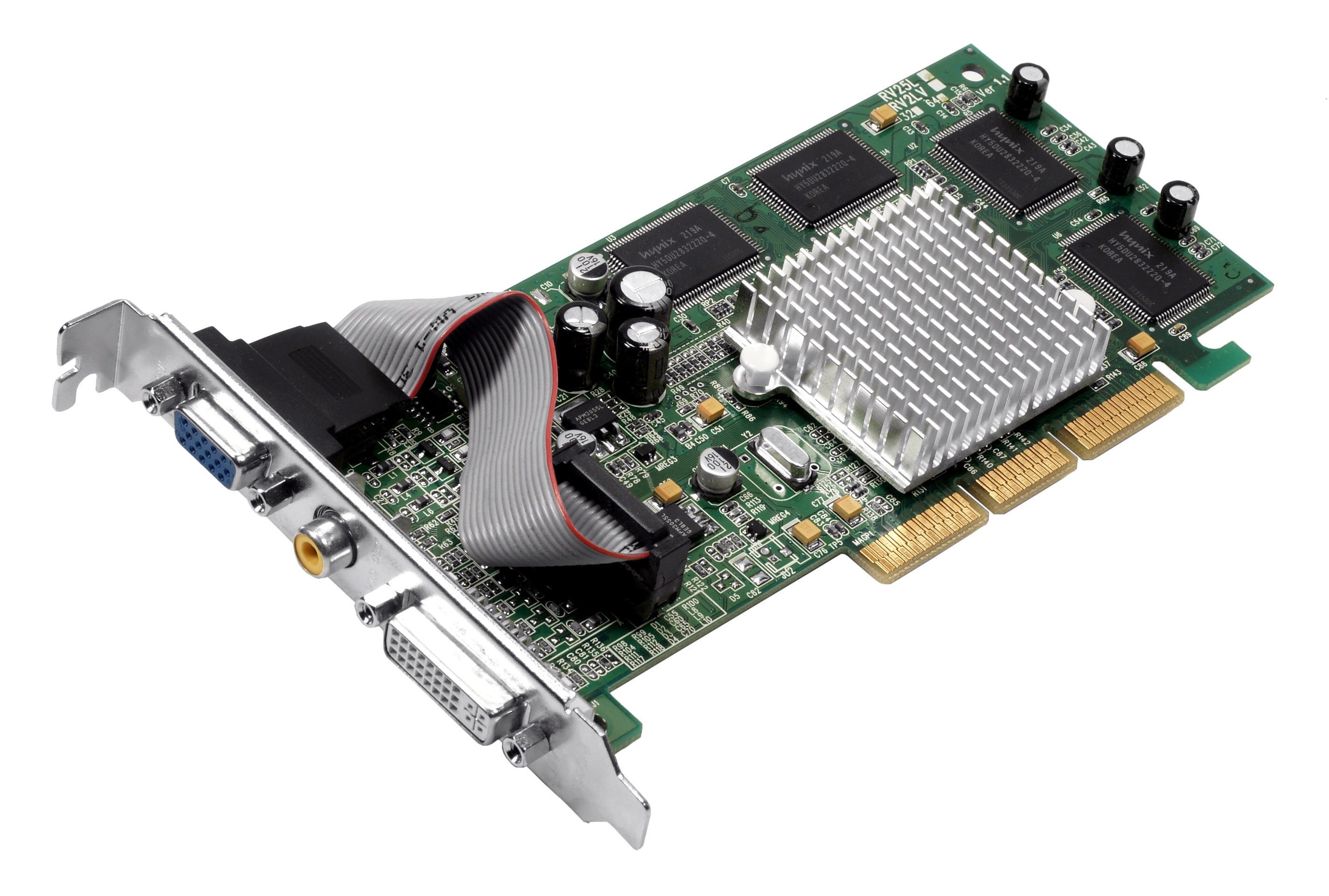
A high performance video card... or is it?

A high performance video card… or is it?

with so many different PC cards, built on so many different chip sets, how do you know which one is the best for you? Why, you run a benchmark program, usually created by the video card manufacturers, and you can then see which card is better! But then a funny thing happened. After a while more and more benchmarks were released, and people started to notice that different benchmarks favored cards from different manufacturers.

If we look back to 2003, we can see a great example of video card cheating. It was summed up by a statement from Futuremark, a benchmark manufacturer, “We have now established that NVIDIA’s Detonator FX drivers contain certain detection mechanisms that cause an artificially high score… We have just published a patch 330 for 3DMark03 that defeats the detection mechanisms”.  And with that, the video card wars were truly underway.

Card manufacturers found ways of cheating the tests, or were releasing their own dishonest tests, and independent testers and benchmark manufactures were fighting back with new code and testing methods. After a while, “cheating” evolved into pure fantasy. Video cards had code to takeover the benchmark software and returning wholly fictitious results. The card manufacturers didn’t seem to care what would happen when their customers found out that they had been lied to. They were far more interested in getting their highest (fake) ratings. That’s the big lesson about benchmarks and tests. When any test or performance goal is critical to a purchase decision, the test process had better be accurately described, tightly monitored and heavily penalized when there is cheating. Without these standards, every corporation will, given enough time, cheat. Because there are too many incentives to allow “everyone else” to cheat.

The same applies to not just car and computer companies. It applies to every organization, and individual, that generates and reports performance metrics in a large corporation. If corporations are willing to use illegal means to cheat on government mandated tests, the desire and ability to cheat on internal metrics must be vastly greater. Was that project completed on time and on budget? Did you reduce your staff as requested… including the temporary workers that no one knows you have? We are all motivated to cheat, even if your firm has a long and comprehensive a statement on ethics.

As corporations head into ever more numerically based business, do we really want to know who is cheating? And do we really want to punish cheaters with severe penalties… or are we more likely to give them a big bonus and a great recommendation for their next job… if everyone keeps quiet? Lets keep an eye on Volkswagen over the next few months  and see what turns up. But let’s also think about reports with performance metrics that are just too good to be true. Because, they just might be. And that’s my Niccolls worth for today!

Posted in Improvement, Project Management Office | Tagged , , | Leave a comment

Law Firms Get a Failing Grade In Document Review


FailureOutsourcing is big business! Today, just about every firm today outsources something. Big firms, little firms, manufacturers, accountants, lawyers and technology firms. All big corporations perform certain common functions: payroll, accounting, PC support, and so on. When you’re ready to outsource you identify the functions that can best benefit from outsourcing, test that your list makes sense, review the most likely vendors and then sign an agreement. That’s the standard process. But not for legal outsourcing. The legal profession has gone off on a different and dangerous path. Can they get back on track?

The culture of the large American legal firm developed more than a century ago, and a lot of that development came from a peculiarity of the legal industry. Over the last century, the largest American (and European) businesses have moved from private ownership to being almost exclusively publicly traded corporations. However, for legal firms, the path to public ownership was barred. Law firms can sell shares to lawyers within the firm, but not to the public. Legal firms overwhelmingly became partnerships, organizations controlled by the founders and major rainmakers. Clients of the firm are for all practical purposes “owned” and managed by individual partners. This culture of partner client relationships creates silos inside of  large legal firms.

In an earlier age, when life was simpler, this culture was effective. Each silo is bound by some company rules, but it maintains significant autonomy. That was all well and good, until the early 80s. Document review, an important but relatively minor activity during a lawsuit where documents requested by the court are collected, read and classified into various collections. Before the arrival of the computer age, this was a relatively simple process, involving a few thousand documents. Suddenly, the nature of computers caused an exponential increase in document volume… especially after the corporate world discovered e-mail! Today a document review in large corporations can involve 5,000,000 pages or more.

The management of a corporate lawsuit used to require few junior lawyers or paralegals, and a more senior lawyer to answer questions. But as review sizes grew, law firms lacked the junior lawyers… and space.. for a large review. A review was no longer a boring and repetitive task to heap onto junior lawyers. Now it was a major project that required the procurement of temporary lawyers, space, and equipment. By the late 90s, corporate clients were noticing that reviews were a rapidly growing legal expense. Some financial firms, specifically Investment Banks, having undergone major internal cost reduction programs themselves, asked their legal firms, “Why aren’t you outsourcing?”

Massive tobacco industry lawsuits drove document reviews to new heights. Teams of hundreds of lawyers would spend years shuffling and re-shuffling documents in the doc review for a single case. Law firms were forced to investigate outsourcing…. First onshore and then offshore. This was a step in the right direction. But then the silos we discussed exerted their influence. Instead of a creating a single high quality, very efficient “document review machine”, law firms developed an outsourcing process that followed their legal culture. Individual lawyers negotiated outsourcing agreements on a case by case basis. By bypassing central administration (if it existed,) cases were kept moving and clients were happy… at least until the bill arrived. While this was horribly ineffective outsourcing, it was still a better option than any other internal solution.

By the turn of the millennium, outsourced discovery and legal review were becoming big business. What was a $300 million business in 2000, grew into a $3 billion market by 2011 and is expected to be $10 billion by 2017. Document review is now a high volume, multi-billion dollar market but is still treated with a “one-off” mentality. This miss-match in the business and the process just doesn’t work. Consider how this “one-off” process has impacted legal outsourcing:

CASE BY CASE: Individual lawyers match the case to the vendor resources,  usually based on their familiarity with the vendors rather than the use of vendor performance metrics. Every lawyer has a different selection process, which includes determining which tools will be used, which vendor will staff the review, AND which vendor/tool will be used to host the document collections. The combination of these factors (lawyer, tools, hosting site, contract conditions, linear vs. TAR, etc.) makes it difficult for any individual lawyer to compare or improve cost, time or results…. Since they only use a limited set of each. Yet, a centralized function (say, procurement) might be able to collect some metrics to show if any specific confirmation of tools and vendors is dramatically more effective.

DIFFERENT TOOLS: Hundreds of review tools are on the market, each with different features, licensing agreements and costs. If tested, some tools would be found to be more accurate or faster. A tool with a higher initial cost per user could easily justify the higher cost if reviewers processed more documents per hour. This would reduce the hours billed, and (depending on how the tool is billed) might require fewer licenses or licenses for a shorter period of time. The number of “documents reviewed per hour, per reviewer” is the key factor for determining the efficiency of the review, and is known to vary dramatically between tools. In a linear (manual) review, a reviewer is expected to examine 40 documents per hour or more. Linear tools have limited automation, such usually have at least basic document sorting and organization features. Advanced tools claim reviewers can complete 200 or more document per hour.

Full blow document review automation (often referred to as Technology Assisted Reviews, or TAR) can read thousands or millions of documents on day one, and then automatically do the reviewer’s job of tagging the documents, with little or no “reviewer” time. While the very conservative legal industry is only beginning to embrace true TAR systems, that provide a dramatically higher quality document review at a significantly lower cost.

CONTINUOUS IMPROVEMENT: Outsourcing is the right step in an ongoing process of improving efficiency. When an outsourcing program begins, several competing processes may be identified. Over time, less effective processes are stripped away and the remaining processes are standardized and become more efficient… even if they stay in-house. Eventually, best processes are identified and applied, and improvement initiatives are developed for any problems that arise. The fractured and siloed management of legal review works against the usual cycle of continuous improvement, making new efficiencies difficult to implement. Individual vendors do learn how to work effectively with a given client, but when a best practice is learned by one vendor, this information is rarely shared with other groups and vendors. With many different products used, expertise is dispersed, and new innovations become unnecessarily rare.

Understandably, the old silo culture is under pressure to change. Some law firms have created centralized, global, outsourcing programs. But his is more likely to be the case for support services, than document review.  Still, the rise of Global Procurement is exposing the many inefficiencies, and the many opportunities to reduce cost. However, to be effective, each legal group’s connection with their own vendors must be broken, and the financial control over these contracts must be moved to an objective contract management group, that can leverage the entire firm’s spend in document review.

PROJECT MANAGEMENT: Tobacco cases started the current trend in mega-lawsuits, but billion dollar lawsuits have taken on a life of their own and have become common. Tobacco litigation is being replaced by lawsuits over: psychiatric drugs, telecommunications, mortgage fraud, the general malfeasance by banks during the collapse of the financial industry. Mega-lawsuits don’t just require a larger number of document reviewers. These reviews may go on for years. That means: more managers, longer-term management, replacing and resizing staff, retraining staff, changing instructions, communicating changes, etc. A review that requires 10 times more staff requires more than 10 times the management.

NEW CHALLENGES: The cost for legal review is growing because the legal industry has not kept up with technology and best practices. Linear review dominates, while more modern TAR is relatively rare, even though TAR produces more accurate results at a lower cost. The explosion in email created the rise in review costs, but email (for the first time in 20 years) is finally on the decline. Rather than going away, email has transformed into social media: Facebook, twitter, LinkedIn and other social media sites. Law firms took decades to understand eDiscovery, which largely deals with information in their client’s hands. Now there is more information in the “Cloud”, outside of the client’s control. Social media requires new tools and different skills. Consider a gaffe on Facebook and Twitter, from Reed Hastings,  Netflix’s CEO. He posted Netflix’s new July record of 1 billion hours of content viewed. Hey, new record… congratulations! Or is that a private message to a privileged group or individuals (insider trading). Or was it a CEO memo to shareholders, or a new release that could manipulate the streaming content market? Whatever it was, it wasn’t vetted by compliance. Ouch!  Legal needs a partner to deal with the issues raised by social media and the “Cloud”.

COST: The cost of litigation rose sharply between 1998 and 2011, increasing from $166 to $281 billion. This rise might have been curtailed if lawyers used the latest technology, or if they outsourced more aggressively. Because of the down economy, many legal firms could rely on outsourced local lawyers and law students to perform reviews. This has worked for years, and the economy is improving, but clients are not showing an appetite for higher rates. If anything, rates continue to be under pressure from clients for lower rates, while law firms are under just as much pressure to raise rates. Some domestic lawyers have been employed at just above minimum wage. Even so, the offshore rate has been lower still. Doc review work has continued to move offshore. However, the record low prices in India provided a one-time benefit. The worldwide economic collapse forced offshore rates to record lows. Yet, offshore inflation has continued to be two to three times that of the US. At some point, prices must rise.

At its most basic, legal review is merely the process of reading documents and finding the ones you need. Today you hire many people to read through the pile, new instructions are periodically issued, and the work is frequently re-worked. This is an incredibly inefficient process. Compare this to a nearly identical process that you perform every day, looking for documents on the Internet. The Internet (or Cloud or Web) is a vast collection of documents and other media. When you want something, you type in or speak a search request, and seconds later Google provides results from its collection of trillions of documents. Search engines aren’t perfect, but they are better than any other method of navigating these documents. Yahoo!’s early search engine relied on human beings entering website information, just as document searches rely on lawyers. But Yahoo abandoned human based “indexing”, decades ago, and built computer-based search engines.

The average legal review takes months to complete and costs nearly $2,000,000 to search a few million documents. Every Google search examines billions to trillions of documents in just seconds. The cost? FREE. A legal review is more complicated than the average Google search, but TAR tools can provide accurate and inexpensive legal reviews. Most legal firms haven’t grasped how great their failure is, producing poor quality results while charging clients millions of dollars more than alternatives. The legal industry gets an “F” for document review. But, don’t worry! Social media and an economic recovery bring new challenges AND the chance to earn a new grade. The creation of documents both inside and outside of the corporation is growing and changing faster than law firms can manage. Law firms need to partner with LPO providers and other knowledgeable experts to meet these challenges. At least, that’s my Niccolls worth for today!

Posted in Best Practices, Delivering Services, Project Management Office | Tagged , , | Leave a comment

Another Industrial Disaster: Crane Collapses in the Middle East


Earlier this week over 100 people, primarily tourists, were killed in a crane collapse in Mecca. As terrible as this accident was, it was not unique. Every year millions of pilgrims the site Mecca to perform the Hajj, a religious obligation to visit holy sites in and around Mecca. In the past the Mecca has seen many disasters that have killed thousands of religious pilgrims, making Mecca the most dangerous tourist location on earth.

Mecca - Mosque

Picture 1: The Grand Mosque of Mecca

Mecca - Clock Tower

Picture 2: The Clock Tower of Mecca

Mecca has hosted religious tourists for centuries. As travel has become easier, and the Muslim world has grown richer, the number of pilgrims has grown. The Mecca of old has been plowed under in a building frenzy, and been replaced with gigantic buildings, including the Mecca Clock Tower. In the past, one of the biggest and most important buildings in Mecca was the Masjid al-Haram (the Grand Mosque), seen in Picture 1. In Picture 2 you can see the Clock Tower (now completed), and in the white area in the middle… between the tower on the right and the construction on the left… you can see a tiny black dot. THAT is the Grand Mosque.

The grand Mosque, and what used to be a humble shepherd’s path nearby, are the primary sites of the Hajj in Mecca. Both of which are now completely surrounded by the new structures. Old Mecca, essentially the purpose of the Hajj, is now buried inside of the “gift shop” that is the new Mecca. Bad taste? Possibly.  But more importantly, by funneling 12 million tourists a year through what appears to be an open construction site, is a massively bad idea. And is an indication of how little attention is given to industrial safety rules.

Mecca is not the only city where where industrial disasters occur. Or even where there are specifically disasters caused by falling cranes. In New York City there was recently a crane collapsed in mid-town Manhattan that killed the operator. A few years ago, in 2012, another Manhattan crane fell and killed two workers. But when a crane falls and it kills over 100 people, it requires spectacularly bad planning and a complete disregard of safety regulations.  Businesses thinking of opening operations in the Middle East might wonder if the super buildings of the middle east are built to the same standards as the US and Europe.

Mass disasters in Mecca have not been limited to worker safety issues. Tourism in Mecca has expanded far faster than safety measures to protect tourists. In 1990 pedestrians on the Hajj stampeded, trampling to death nearly 1,500 pilgrims. Similar, though somewhat smaller stampedes seem to happen every few years: in 1994 (270), 1998 (118), 2004 (251), and 2006 (346). Despite Mecca’s role as the destination for millions of Pilgrims every year, and despite the investment in luxury hotels and skyscrapers, there is a fundamentals gap when it comes to providing safety.

Just a short time ago I wrote about the explosion in Tianjin, that killed over 170.  There too, a lack of basic safety regulation led to a completely avoidable tragedy. The city of Mecca is filled with construction that may continue for decades to come. As more accommodations are built, we can expect more tourists. In just the next few years, Mecca’s 12 million tourists are expected to rise to 17 million.  A lot of tourists, who are essentially touring a construction site, is a pretty obvious formula for more industrial disasters. Saudi Arabia needs to put more attention into safety, and a bit less into the glitz of the tourist trade. Whether you are traveling to a country for tourism or to move your business, safety maters. At least that’s my Niccolls worth for today.

What do you think?

Posted in Uncategorized | Leave a comment